Ferrari F40 – Enzo’s last great yes
An anniversary car with a racing car’s priorities
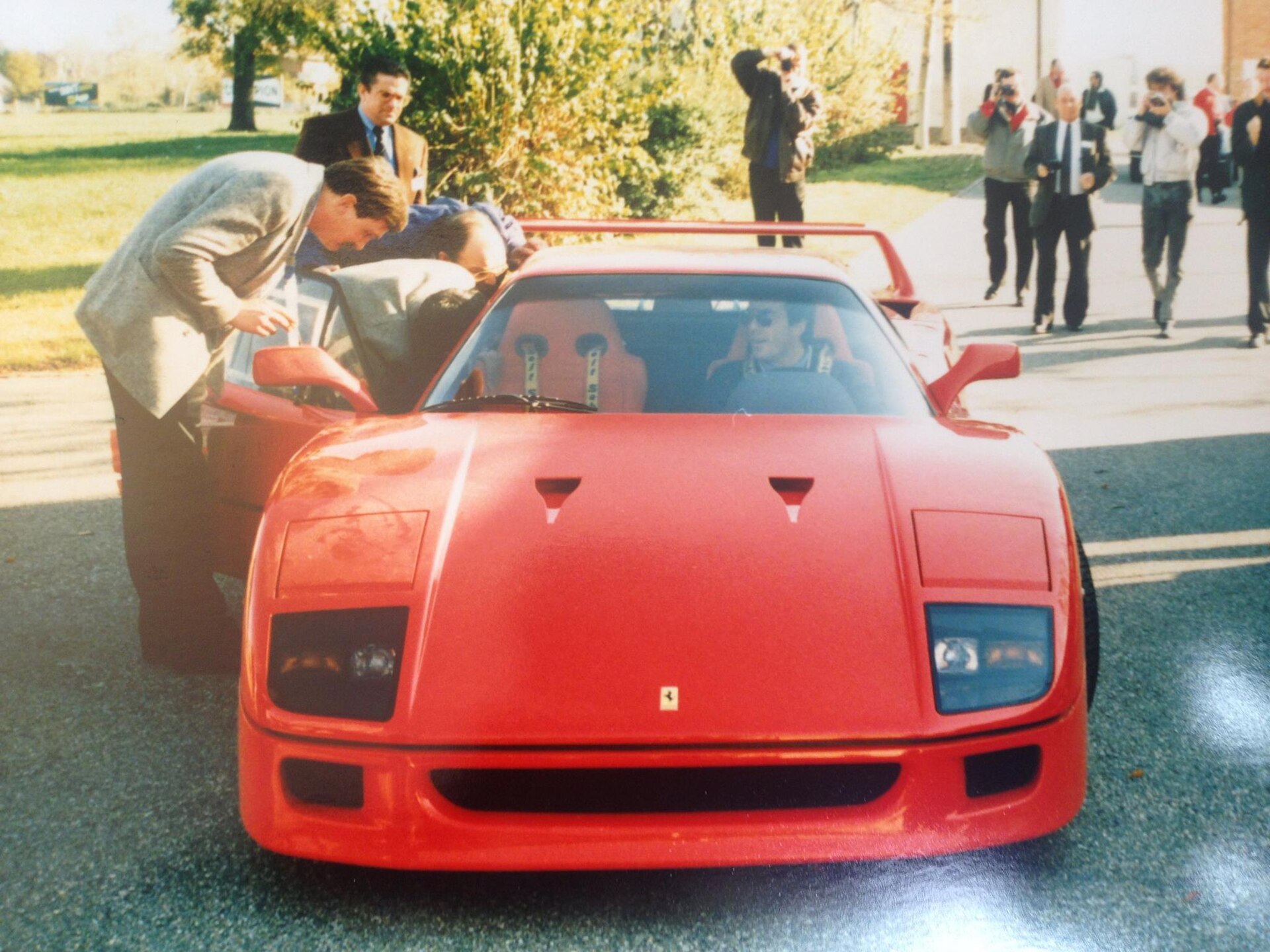
Two turbochargers, composite bodywork and almost nothing between driver and machine. The Ferrari F40 was unveiled in 1987 as the marque’s fortieth birthday present – and became the last new Ferrari model approved by Enzo Ferrari before his death. Its greatness lies as much in what was left out as in its 478 horsepower.
 By Nora LindqvistReporter · Sports cars and motorsport
Translated from Swedish with the help of AI.
Forty years, one final green light
The 1987 Ferrari F40 is a two-seat, mid-engined road-going sports car, built by Ferrari in Maranello with body styling by Pininfarina. It was unveiled in July that year, as the marque celebrated forty years as a car manufacturer. Enzo Ferrari was still alive and gave the project his approval. He died in August 1988; the F40 thus became the last new Ferrari model launched during his lifetime.
The starting point was not a blank drawing board. Ferrari had developed the 288 GTO and then the more radical GTO Evoluzione with competition ambitions. When the circumstances surrounding Group B changed, that experience instead helped shape an extreme road car. The F40 was therefore not a racing car simply fitted with number plates, but its technical kinship with the competition projects was clear.
The brief was also unusually focused: high speed, low weight and a direct connection between driver and machinery. The contemporary Porsche 959 demonstrated what sophisticated four-wheel drive and electronic control systems could achieve. Ferrari chose rear-wheel drive, a manual gearbox and considerably fewer driver aids. Two different answers to the same question: how do you build one of the world’s fastest road cars?
Turbo V8, unfiltered
Behind the cabin sits a longitudinally mounted V8 of just under three litres, with twin overhead camshafts per cylinder bank and four valves per cylinder. Two IHI turbochargers force in air, while intercoolers lower its temperature before it reaches the intake. This makes the charge denser and helps the engine produce high power from a relatively small displacement.
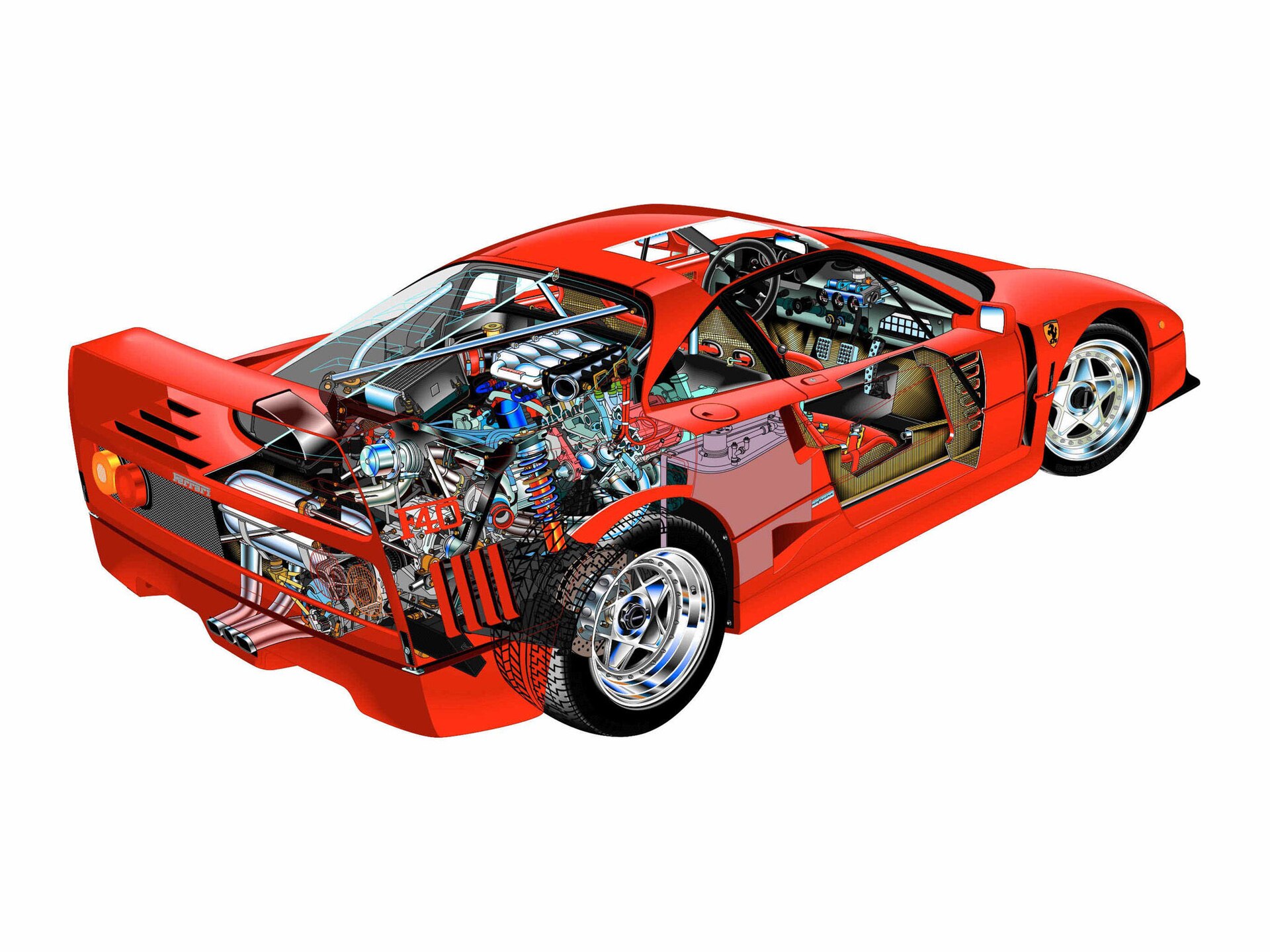
Ferrari quoted 478 metric horsepower at 7 000 revolutions per minute. Power goes through a five-speed manual gearbox to the rear wheels. The gear lever’s open metal gate is not nostalgic decoration: here, the driver’s work with the clutch, gear selection and throttle is central to how the car functions.
The turbochargers do not deliver the same immediate response as a naturally aspirated engine. Boost pressure depends on both engine speed and load, making careful throttle application important as the power builds. Without traction control, the driver must manage the boundary between acceleration and wheelspin. That is a technical reality, not a driving impression from the editorial team.
Ferrari’s claimed top speed was 324 km/h, with 100 km/h reached in 4,1 seconds. The figures describe the factory’s performance claims, not a guarantee for every car or every set of test conditions. For a road car in 1987, they were nevertheless a clear statement of ambition.
Form working for speed
The F40’s low nose, air openings and tall, fixed rear wing give the car an almost diagrammatic clarity. Air must be directed to the radiators, engine and brakes, while the bodywork must keep the car stable at high speed. The rear wing uses pressure differences to apply aerodynamic load to the rear axle; the gain in stability comes at a cost in drag.
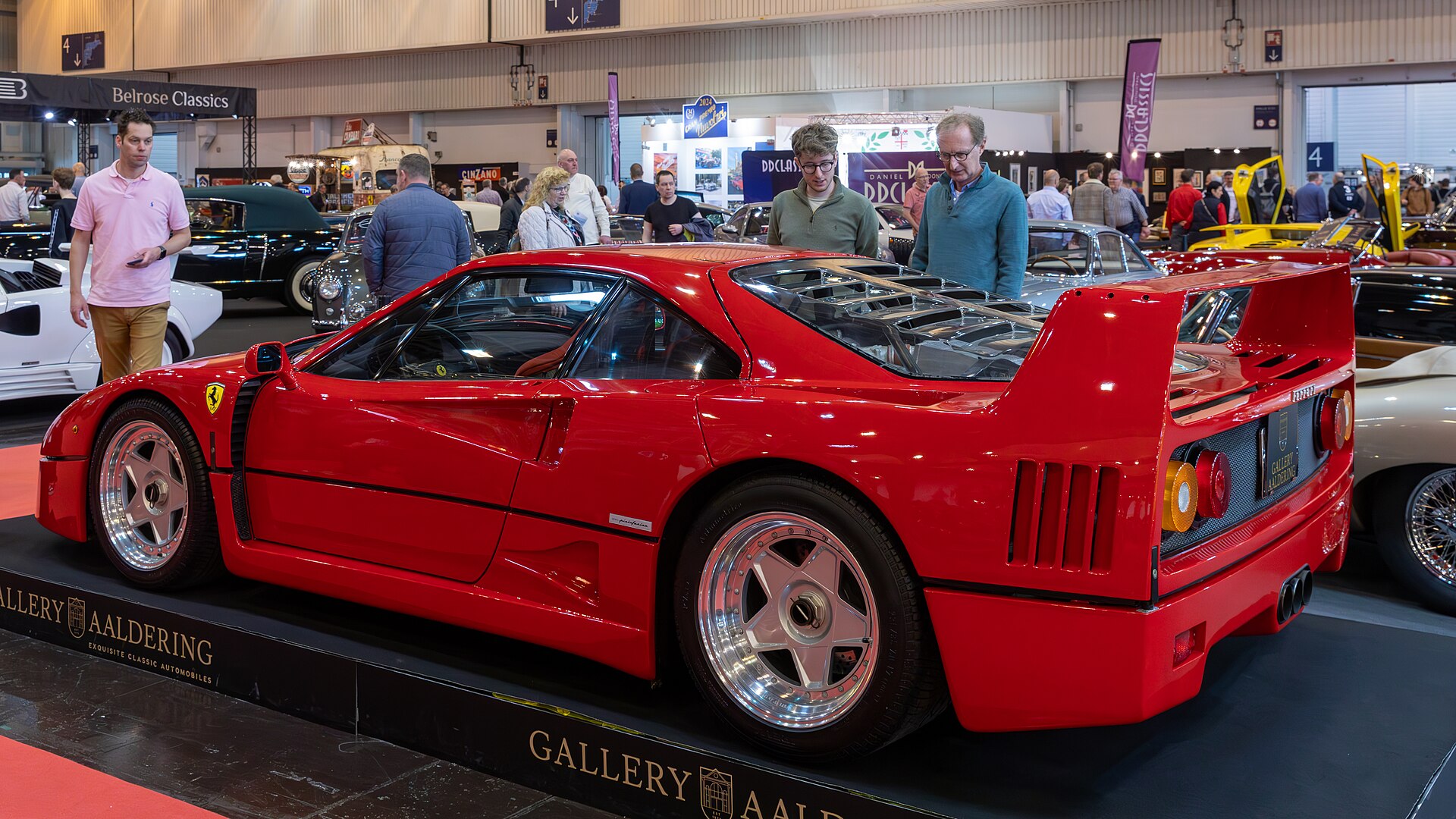
Beneath the skin is a tubular steel frame combined with composite materials. The bodywork uses carbon fibre and aramid fibre, among other materials. The F40 should therefore not be described as a modern car with a load-bearing carbon-fibre monocoque. Lightweight materials were important, but they formed part of a structure that also built on Ferrari’s established methods.
Ferrari quotes a dry weight of 1 100 kilos. That is not the same as a road-ready weight with fluids and fuel, a distinction easily lost when discussing the model’s power-to-weight ratio.
The suspension uses double wishbones, and the brakes are ventilated discs. Neither ABS nor power steering is fitted. The cabin follows the same priorities: simple door panels, minimal trim and clearly visible structural materials. Air conditioning was available, however. Stripped-back did not mean every practical feature had to go.
From speed machine to collector’s car
The F40 remained in production until 1992, with a total of 1 311 examples built. It is therefore rare, but no one-off prototype. Separate competition versions also followed; their specifications should not be confused with those of the road car when comparing power, weight or history.
Today, documentation determines much of an individual car’s appeal. Service history, verified identity, accident repairs and the body’s composite panels need to be scrutinised. Original specification and any changes between different market versions also matter. An auction result is therefore not a reliable valuation of the next example.
This is where the F40’s dual identity becomes clear. It is a collector’s item associated with Enzo Ferrari’s final years, but also a machine built around very concrete priorities. Two turbochargers. A manual gearbox. Rear-wheel drive. And a driver still expected to do the work.
Sources
- Ferrari, Ferrari F40
- Leonardo Acerbi, Ferrari: All the Cars (2006)
- Ferrari, Museo Ferrari
Ask questions about “Ferrari F40 – Enzo’s last great yes”. Answers are based on the magazine's own articles.