Peel P50 – the world’s smallest car with a handle at the back
From the Isle of Man to Top Gear and back into production
One seat, three wheels and no reverse gear. The Peel P50 of 1962–1965 made the term small car almost literal. But behind its comical dimensions lay a perfectly understandable idea: why build more car than a lone driver needs?
 By Henrik SjöbergReporter · Special cars and classic cars
Translated from Swedish with the help of AI.
A real car, just a very small one
The Peel P50, the original model from 1962–1965, is a three-wheeled microcar built by Peel Engineering on the Isle of Man. So it is neither a fairground prop nor a shrunken toy, even if its proportions tend to make your brain suspect otherwise. Guinness World Records recognises the model as the world’s smallest production car. The word production matters: the record does not cover every home-built miniature vehicle that someone has managed to drive.
Behind the project was a company with experience in fibreglass. The P50’s design is associated with Cyril Cannell, and the car was an attempt to carve out a niche among the small vehicles of the post-war era. While conventional small cars offered several seats and at least some sort of luggage space, Peel concentrated on the bare essentials.
The aim was simple: one person should be able to travel under cover without having to buy and park a full-sized car. The British launch price is usually quoted as 199 pounds in 1962. Cheap, yes, but the buyer also had to accept that the term family car was not part of the brief.
Fibreglass with room for one
The original’s body is roughly 1.34 metres long and 99 centimetres wide. That makes the P50 shorter than many adults are tall. Its height is around 1.20 metres, so the result is more of a narrow, upright cabin than a low-slung car in miniature. You sit more or less in the middle of the entire structure.
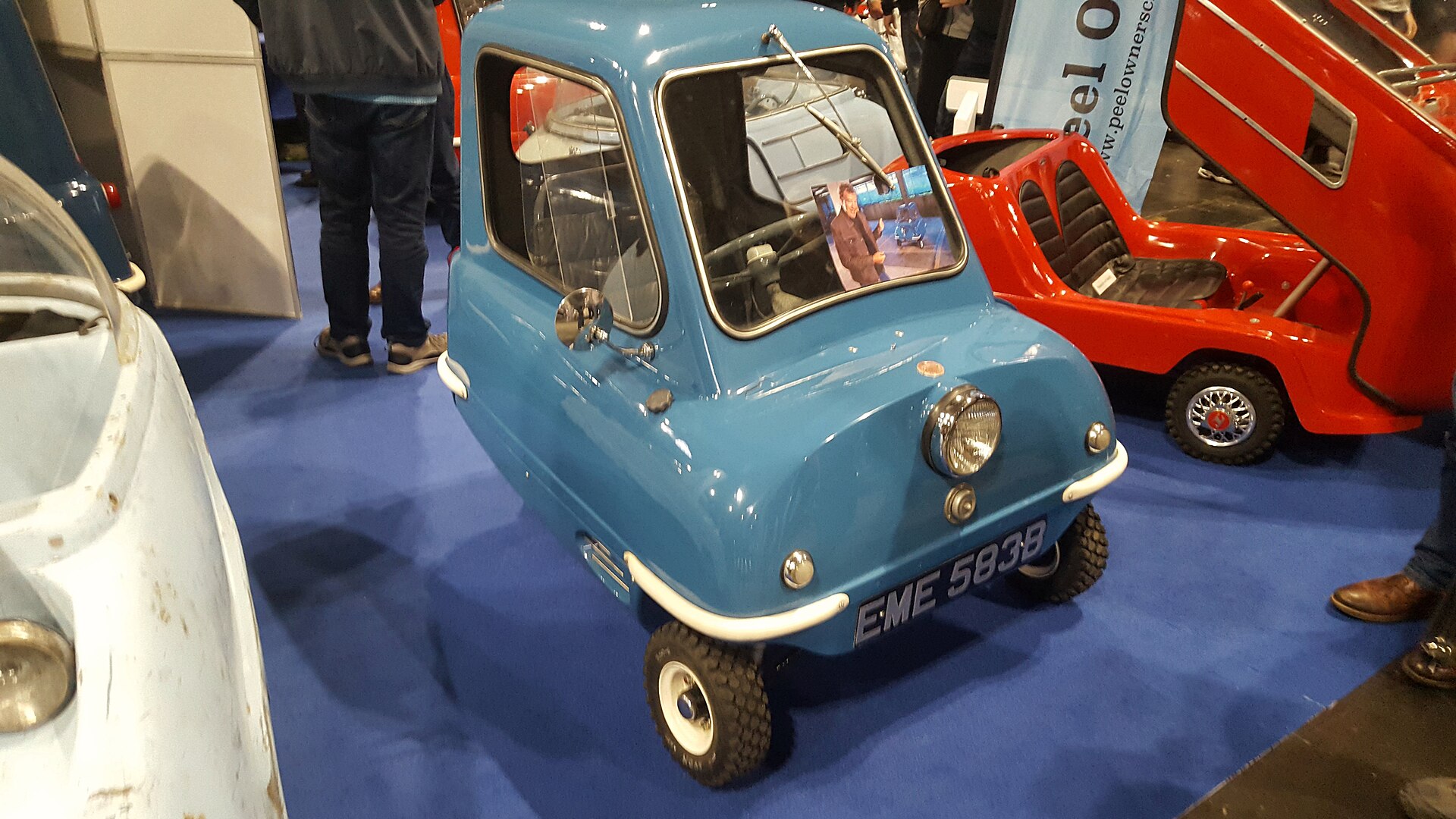
The fibreglass shell kept weight down and suited small-scale production better than an expensive pressed-steel body. Two wheels at the front and one at the rear provided a simple basic layout. A single door on the left gave access to the cabin, while one headlamp up front was enough to give the car its slightly startled expression.
This is also a car whose details explain the whole. There is no extra door for a passenger, because there is no passenger seat. The space around the driver is the car itself, not a room built inside it. Anyone examining a P50 should therefore think more in terms of a weather-protected personal transport device than a conventional small car.
When buying an original, the condition of the body, previous repairs and documented identity are important. Fibreglass can be repaired, but shiny paintwork tells you nothing about how the work beneath the surface has been carried out. For such a rare car, the correct components and a coherent ownership history also carry considerable weight.
Forwards by engine, backwards by hand
Power came from a small single-cylinder two-stroke engine from Germany’s DKW, coupled to a three-speed manual gearbox. The engine sat to the driver’s right and drove the rear wheel. It was a compact solution, but hardly a recipe for refined, insulated motoring.
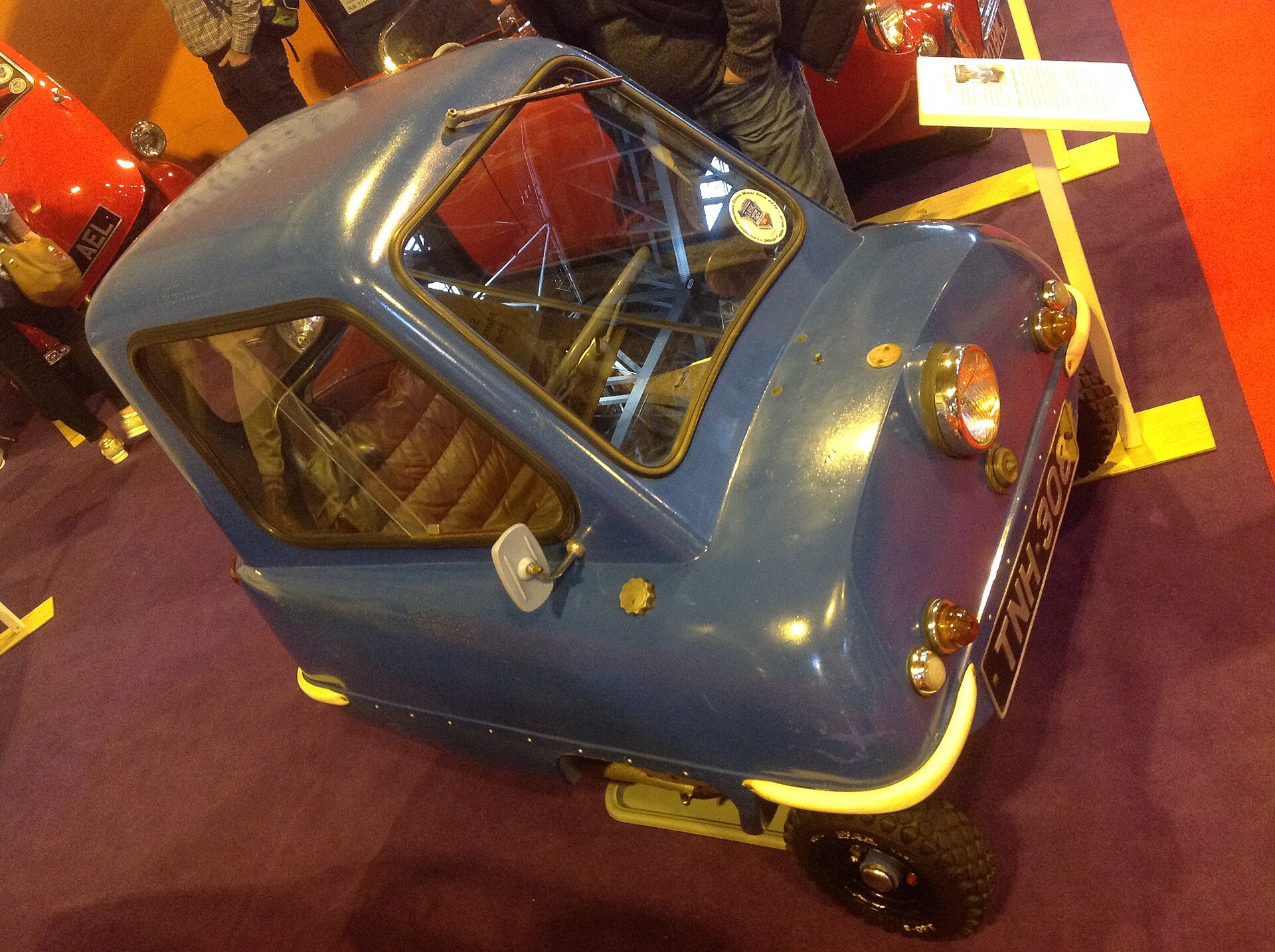
There was no reverse gear. Instead, the driver could get out and move the car using a handle at the rear. With a quoted weight of around 59 kilos, this was actually a workable solution. If necessary, parking therefore ended with the driver manoeuvring what amounted to an unusually expensive suitcase.
Its role was short, straightforward journeys with very little need for parking space. The low weight made the car manageable by hand, but of course it was no substitute for the space or protection offered by larger cars. The P50 should be understood in the context of the microcar ideas of its time, not as a practical alternative to today’s conventional small car.
TV fame and a second life
Its big modern breakthrough came on Top Gear in 2007. Jeremy Clarkson drove a P50 through London and then took it inside the BBC’s offices. The programme made use of the car’s genuine defining feature: it was so small that the boundary between vehicle and office furniture suddenly became negotiable. It was entertainment, not a normal road test, but few motoring features have demonstrated external dimensions quite so clearly.
The Peel name was later revived with newly built P50 cars produced in small batches. These should not be confused with originals from the Isle of Man: specifications and powertrains can differ, and a modern example does not automatically acquire an original vehicle’s history or collector value.
For buyers, that distinction is crucial. An original belongs to a very narrow collectors’ market where provenance and condition determine its value. A newly built car instead calls for checks on its current specification, delivery terms and the possibility of registration in Sweden. The size is still amusing. Unfortunately, the paperwork is full-sized.
Sources
- Guinness World Records, Smallest production car
- BBC, Top Gear: Series 10, Episode 3 (2007)
- Peel Engineering, Peel Engineering
Ask questions about “Peel P50 – the world’s smallest car with a handle at the back”. Answers are based on the magazine's own articles.