Amphicar 770 – the car that took to the water
Two propellers, four wheels and unusually important door seals
The Amphicar 770 was meant to turn the boat ramp into an ordinary road junction. The West German amphibious car never became a mass-market product, but its combination of a British engine, a buoyant steel body and twin propellers makes it one of motoring history’s most charmingly eccentric designs.
 By Henrik SjöbergReporter · Special cars and classic cars
Translated from Swedish with the help of AI.
A car with an extra way out
The Amphicar 770 from the 1961–1968 period is an open-top, four-seat amphibious car, designed both to drive on roads and to travel through water. Behind the project was German designer Hans Trippel, who had worked on amphibious vehicles long before this civilian model. Production took place in West Germany within the Quandt group, with Deutsche Waggon- und Maschinenfabriken in Berlin among those involved.
The model was unveiled in 1961 and aimed primarily at the USA. There was both spending power and an abundance of lakes, ramps and leisure boat owners who might be tempted by a car with a propeller. This was no military off-roader in its Sunday best, but a leisure car intended to make the journey itself an outing.
The model name was almost a miniature instruction manual: 770 referred to roughly seven knots in water and 70 miles per hour on land. These were claimed top speeds, not a promise that every launch would turn into a high-speed adventure.
Around 3 878 examples were built. The dates do need a footnote, however: 1961–1968 is often given as the model’s lifespan, but production, sales from stock and registration years do not always coincide. For any individual collector’s example, production details therefore need to be distinguished from first registration.
A floating body, British machinery
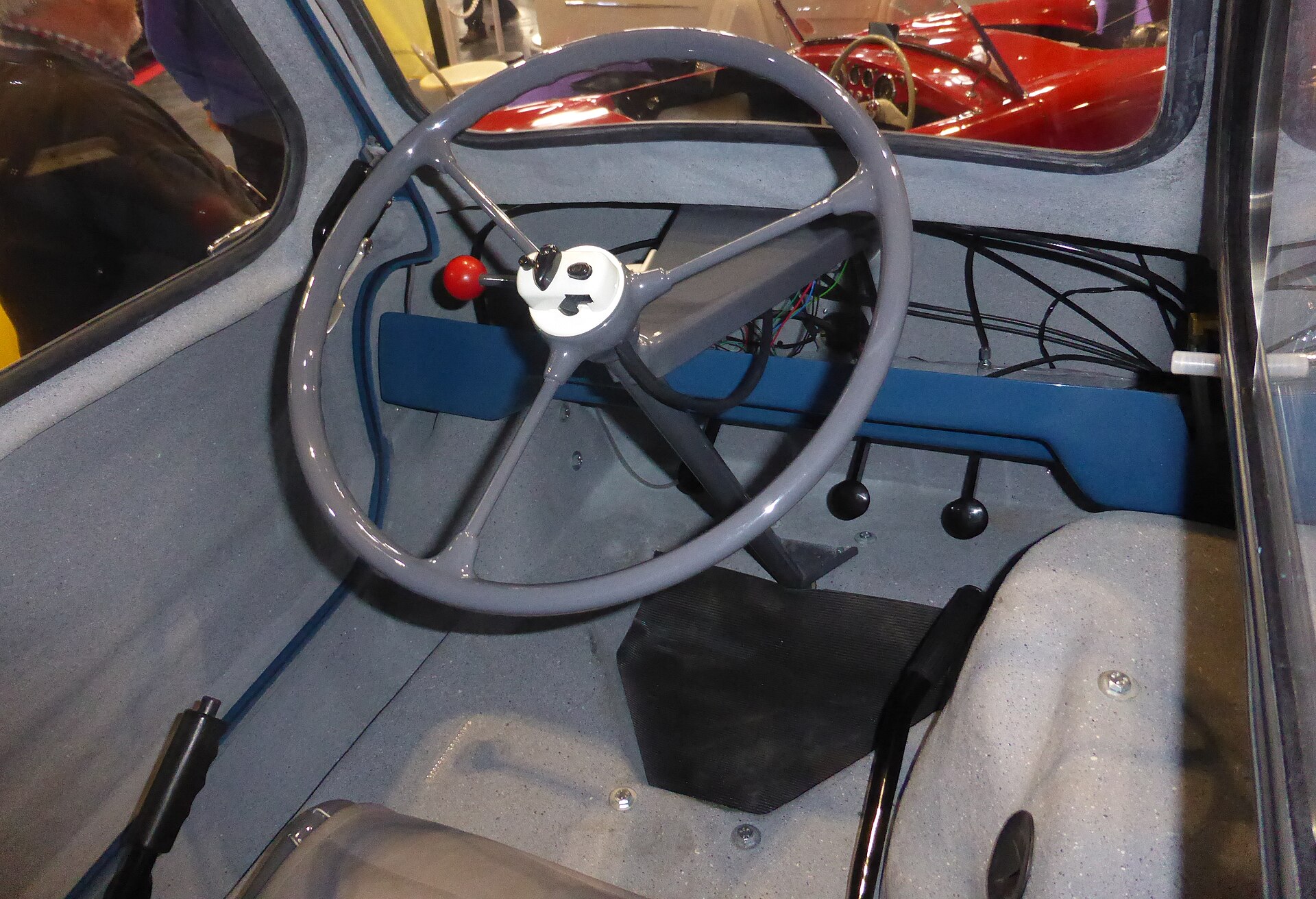
At first glance, the Amphicar looks like an unusually tall little convertible. The fins, round headlamps and simple dashboard clearly belong to the early 1960s. But beneath that friendly exterior is a welded steel body that also serves as the boat’s hull.
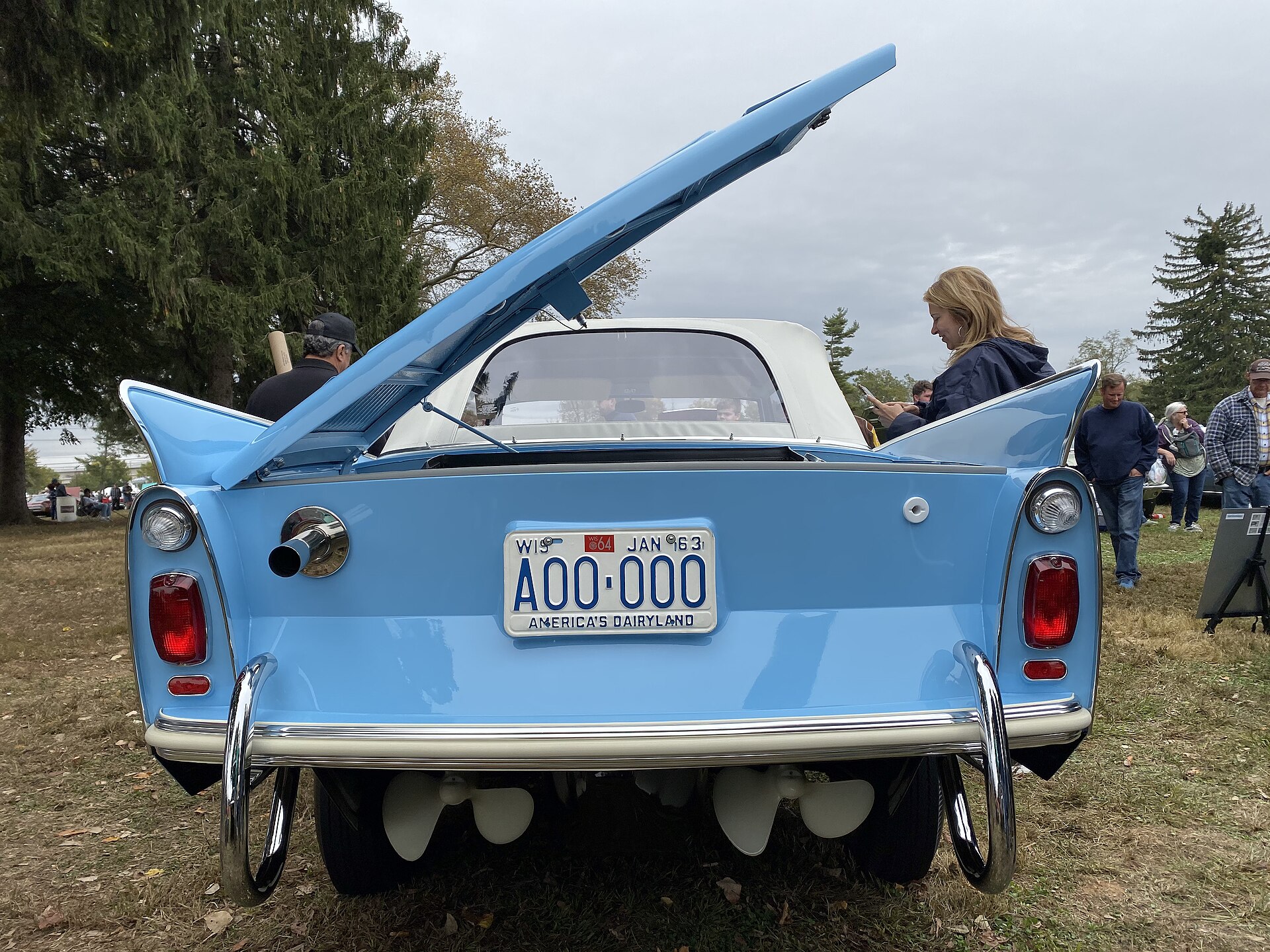
The generous ground clearance made room for the special equipment needed for travel on water. Two propellers sit beneath the stern, while the engine is mounted at the rear. The four-cylinder engine came from the Triumph Herald: fairly everyday British machinery in a decidedly unusual German application. Using an established passenger-car engine meant the designers did not have to invent that part of the adventure as well.
The drivetrain, on the other hand, was specialised. A dedicated transmission from Hermes distributed drive to the rear wheels and the propellers respectively. The wheels and propellers could be used simultaneously, which was important when the car had to climb a ramp and become an ordinary road user again.
The door seals and additional locking mechanism were far more than details to keep the rain out. They were fundamental to the car’s ability to function as a vessel. A bilge pump was fitted too. On an ordinary convertible, a tired rubber seal can mean wet trouser legs; here, the consequences were potentially much greater.
The steering wheel went out on the lake too
The transition to water required preparation, not just a confident right turn at the bathing spot. The seals, locking mechanism and bilge pump needed to work, and a suitable entry point and the ability to get back out had to be assessed. A shoreline is not automatically a boat ramp, however optimistic the driver may be.
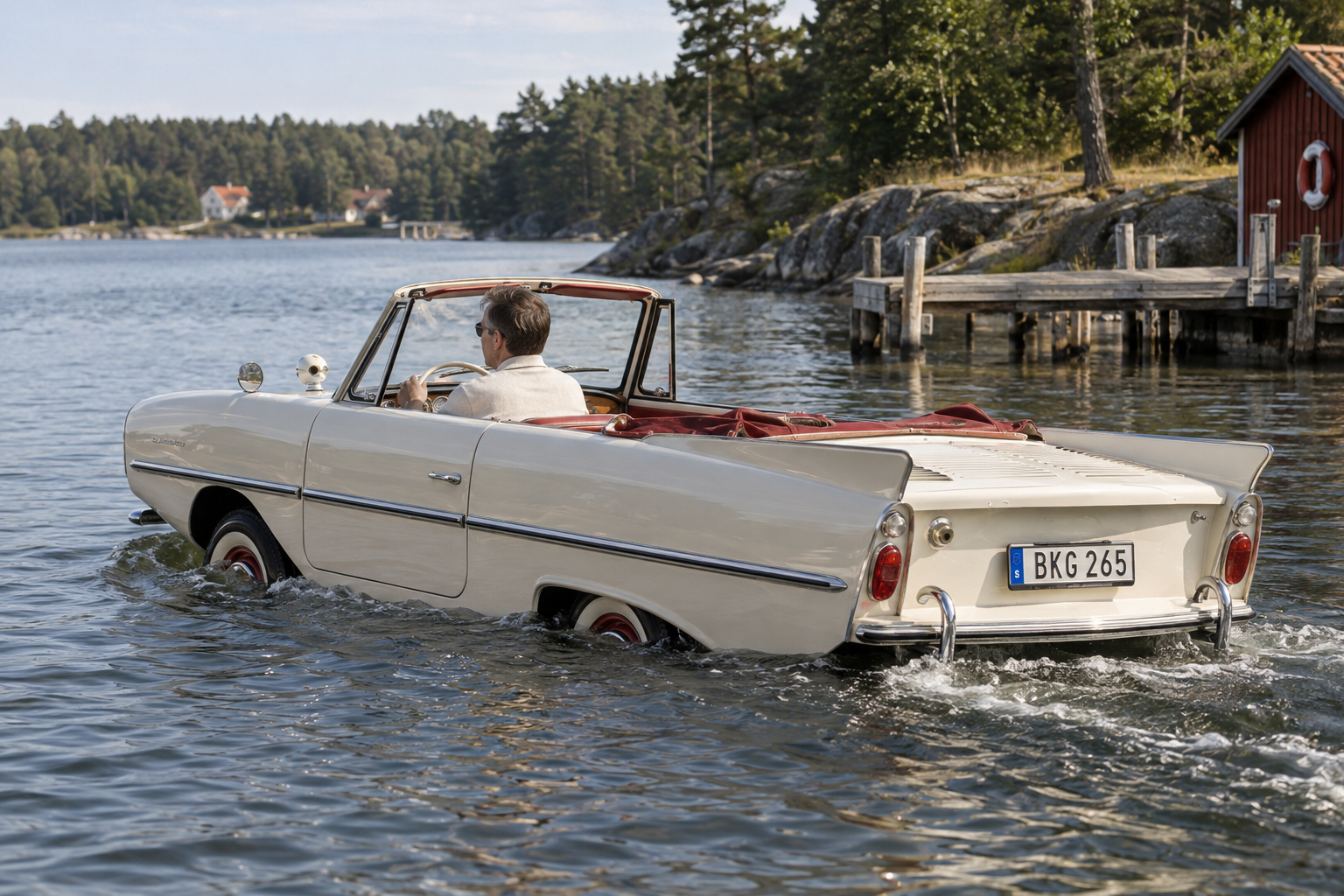
Once in the water, the driver continued to use the steering wheel. The front wheels acted as rudders, while the two propellers provided propulsion. There was therefore no separate boat rudder. The design dispensed with a dedicated steering mechanism, but wheels are not as effective in water as a proper rudder.
The Amphicar was intended for leisure use on sheltered waters, not as a substitute for a seagoing motorboat. Nor did the car’s ability to swim make it immune to the effects of load, weather and waves. Its great selling point was instead the ability to carry on where the road ended, without a trailer or a change of vehicle.
After a dip, maintenance awaited. Lubricating and checking parts that had been submerged was part of using the car. Salt water made the risk of corrosion particularly troublesome. Anyone picturing nothing but an ice cream in one hand and the steering wheel in the other had missed part of the owner’s manual’s message.
A collector’s car with two kinds of condition
Today, the Amphicar is an established specialist collector’s car. No meaningful valuation can be made on the strength of shiny paint and tidy seats alone, however. Its value as a collector’s car must be assessed individually, taking account of documentation, originality, restoration quality and functioning amphibious equipment.
The underside of the hull, welds, door seals, propeller shaft seals and transmission are key inspection points. A car can be roadworthy without being safe to launch. When buying, any claim that it is ready for the water should therefore be backed up by an expert inspection, not the seller’s holiday photographs.
That is also where the Amphicar’s appeal lies. As an ordinary car, there are simpler alternatives, and the same goes for boats. But few collector vehicles turn an entirely everyday boat ramp into the highlight of the journey.
Sources
- International Amphicar Owners Club, International Amphicar Owners Club
- Lane Motor Museum, Amphicar – 1964
- Nick Georgano (red.), The Beaulieu Encyclopedia of the Automobile (2000)
Ask questions about “Amphicar 770 – the car that took to the water”. Answers are based on the magazine's own articles.