Toyota Sera – the small car with supercar doors
A Japanese glasshouse with a surprisingly big impact
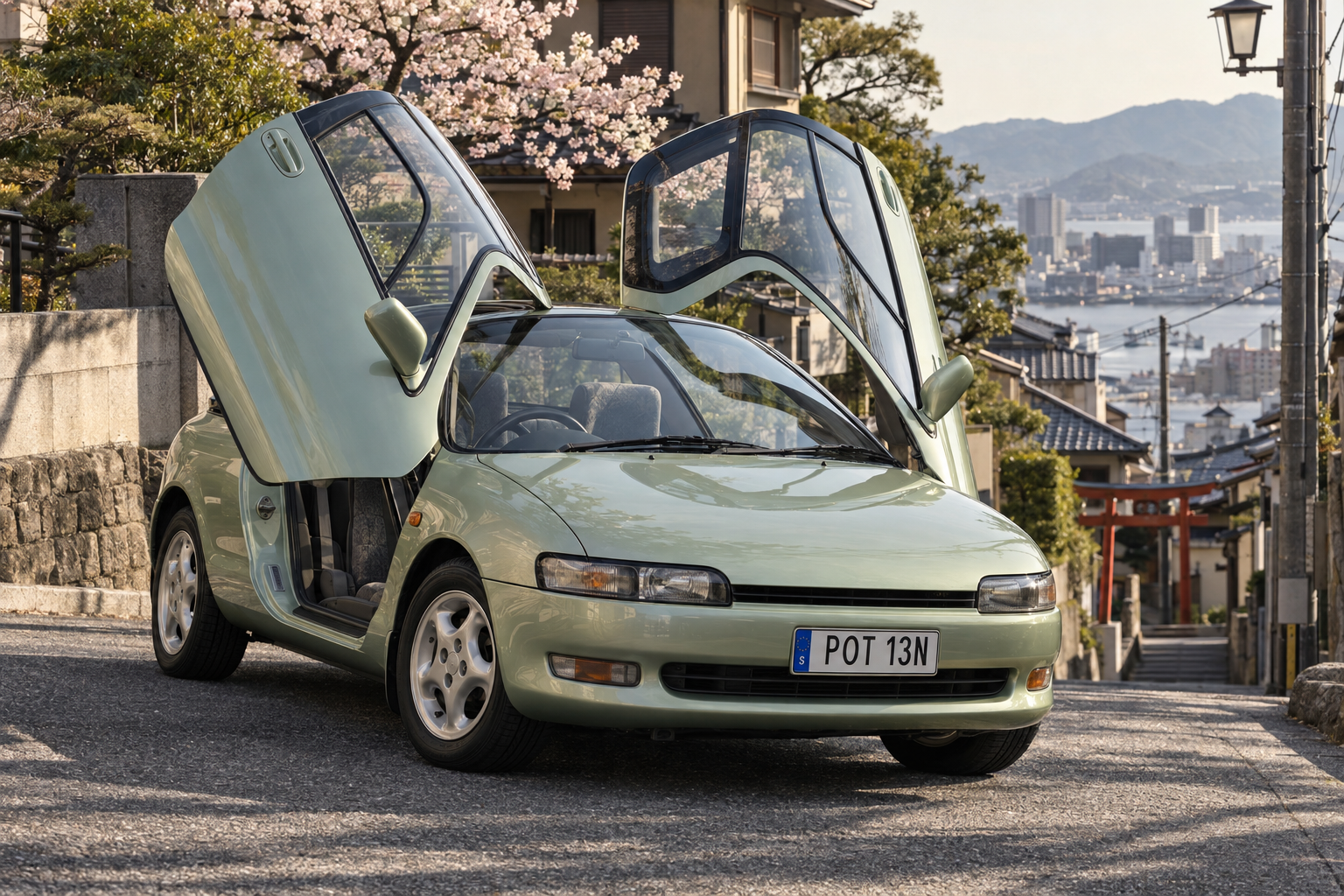
Beneath the glass sits a fairly ordinary Toyota. But open the Sera’s doors and the car park becomes a motor show. The little Japanese coupé from 1990–1995 brought concept-car theatre to the road – and gave the McLaren F1’s designer an idea.
 By Henrik SjöbergReporter · Special cars and classic cars
Translated from Swedish with the help of AI.
From show stand to number plate
The Toyota Sera, model code EXY10, was built from 1990–1995 and was a compact, front-wheel-drive coupé for the Japanese domestic market. This was no miniature supercar, at least not under the bonnet. There sat a four-cylinder 1.5-litre engine related to those in Toyota’s small cars. Above the waistline, however, someone had clearly been given considerably more freedom.
Its origins lay in the Toyota AXV-II concept car, shown at the 1987 Tokyo Motor Show. It combined compact exterior dimensions with large, curved expanses of glass and upward-opening doors. Such things usually stay on a turntable, while the production car gets conventional doors and an excuse. The Sera retained a surprising amount of the idea.
That also explains the car’s distinctive character. Toyota was not primarily trying to win a power war, but to make the shape itself and the act of getting in an experience. Proven small-car mechanicals beneath an elaborate skin created a car that looked far more exotic than its powertrain was. It was not officially sold new in Sweden; Swedish examples are imports.
The doors that found their way to McLaren
The Sera’s butterfly doors move both upwards and outwards. They are therefore neither conventional gullwing doors, which mainly swing upwards from the roof, nor pure scissor doors. Hinge points near the top of the windscreen pillar and further forward on the body create the angled opening movement. Gas struts help lift and support the large doors.
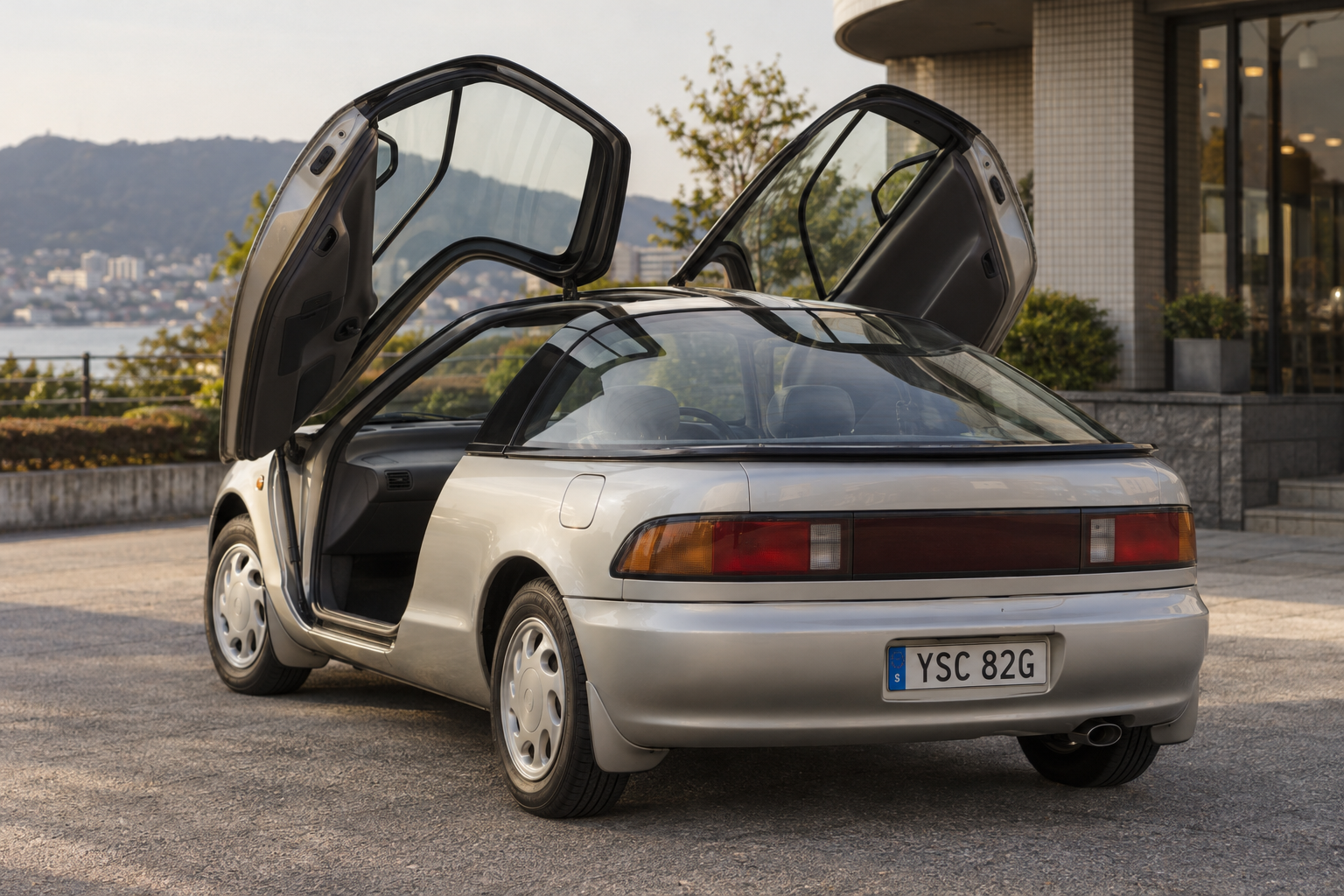
The glass is part of the whole performance. The doors extend up over the occupants’ heads and, together with the windscreen and large rear window, create a cabin with an unusually generous view of the sky. Smaller opening side windows sit within the large glass panels. Here, door, roof and side window are not three obviously separate things.
The link to the McLaren F1 is more than a resemblance in photographs. Gordon Murray has said that a neighbour’s Sera caught his attention and that he studied its door arrangement while working on the F1. The Toyota became a source of inspiration for McLaren’s upward- and outward-opening doors. That does not mean McLaren used Toyota parts or copied the entire mechanism: the cars had completely different structures and design requirements.
Even so, that is quite a wonderful career for a little Toyota. The engine stayed in the small-car class; the door concept got to rub shoulders with one of the world’s most famous supercars.
An everyday car beneath a glass roof
The Sera had two front seats and a small rear bench. It was intended as a personal coupé rather than a fully fledged family car. Front-wheel drive and a choice of manual or automatic transmission suited everyday use better than track driving. Anyone looking to understand the car should therefore start with the cabin, not lap times.
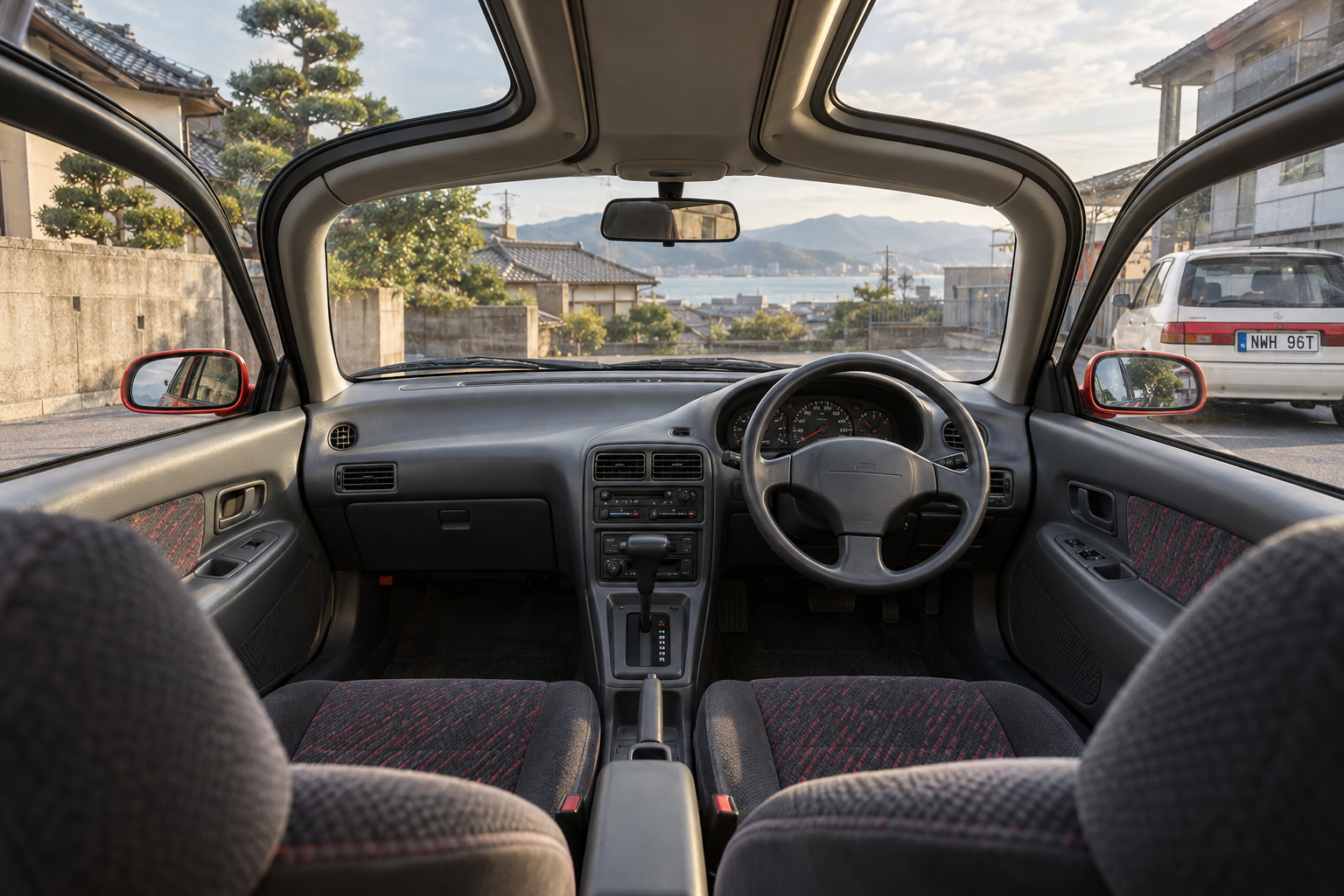
The extensive glazing has a clear downside: the cabin can get very hot in sunshine. Removable interior roof shades help, but working air conditioning is particularly valuable here. When buying, check that the shades are still present and that the system actually cools, rather than merely having a fan that sounds convincing.
The doors’ gas struts are another practical checkpoint. A door should stay safely open without its owner having to act as an extra prop. Tired struts need replacing with parts of the correct specification. The door’s unusual movement also means clearance should be tested in your own garage: a compact car does not automatically mean trouble-free opening beneath every roof.
Buy the glass and rubber first
For today’s buyer, originality and a full complement of equipment matter, but condition counts for more than a shiny presentation. Check the seals around the door and roof glazing, look for signs of damp in the upholstery and inspect the fit of the doors. A careful water test can reveal more than photographs taken in sunshine.
The parts situation calls for the same distinction as the car itself. Some mechanical service components have equivalents in other Toyota models, but compatibility must be checked against part numbers. Glass, seals, body panels and trim, and interior parts are considerably more model-specific. Do not assume everything is available new off the shelf; used parts and specialists may be needed.
The Sera should therefore be valued on a car-by-car basis, taking account of documentation, previous repairs and missing parts. A cheap restoration project can become expensive if the wrong pane of glass or seal is missing. The best buying rule is simple: do not choose solely on the strength of the doors’ performance. Check that they still seal properly once the applause has died down.
Sources
- Toyota Motor Corporation, 75 Years of Toyota (2012)
- Doug Nye, Ron Dennis och Gordon Murray, Driving Ambition: The Official Inside Story of the McLaren F1 (1999)
- Toyota Motor Corporation, japansk försäljningsbroschyr, Toyota Sera (1990)
Ask questions about “Toyota Sera – the small car with supercar doors”. Answers are based on the magazine's own articles.