Cord 812 – the luxury car that hid its headlights and broke the rules
Gordon Buehrig’s bold styling met V8 power and front-wheel drive
With its low body, concealed headlights and a gearbox that let the driver select the next gear in advance, the Cord 812 looked as though it came from another age. The 1937 model year marked the end of a brief but remarkable chapter in American motoring history.
 By Lars EkströmEditor-in-chief · Veteran cars and motoring history
Translated from Swedish with the help of AI.
At the New York motor show in November 1935, visitors encountered an American luxury car that lacked both the customary tall radiator grille and substantial running boards along its sides. Its headlights were nowhere to be seen either. This was the Cord 810, predecessor to the 1937 Cord 812. Its styling attracted immediate attention; getting this advanced car to work reliably in customers’ hands would prove more difficult.
The focus here is the 1937 Cord 812 Beverly sedan: a four-door luxury car with a naturally aspirated V8, built by Auburn Automobile Company in Indiana. The same model family also included open body styles and supercharged versions. No particular surviving car is being described, so there is no individual chassis number or state of restoration to report.
Buehrig’s low-slung American luxury car
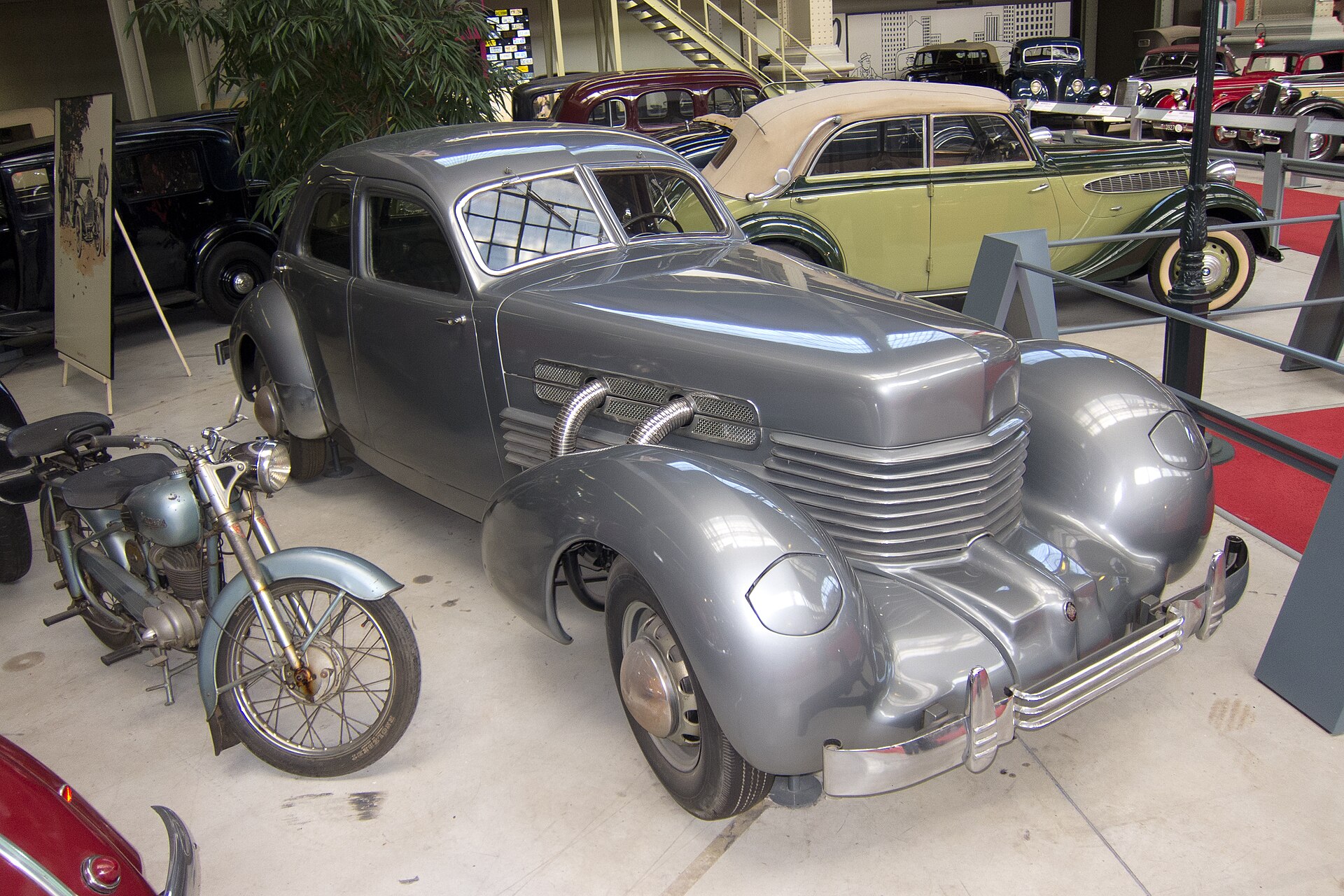
The styling was the work of Gordon Buehrig and his colleagues. Their task was not simply to decorate a chassis. They created a cohesive body whose proportions set the car apart from contemporary American luxury models: a broad bonnet, rounded wings and a front end with horizontal slats that continued around the corners.
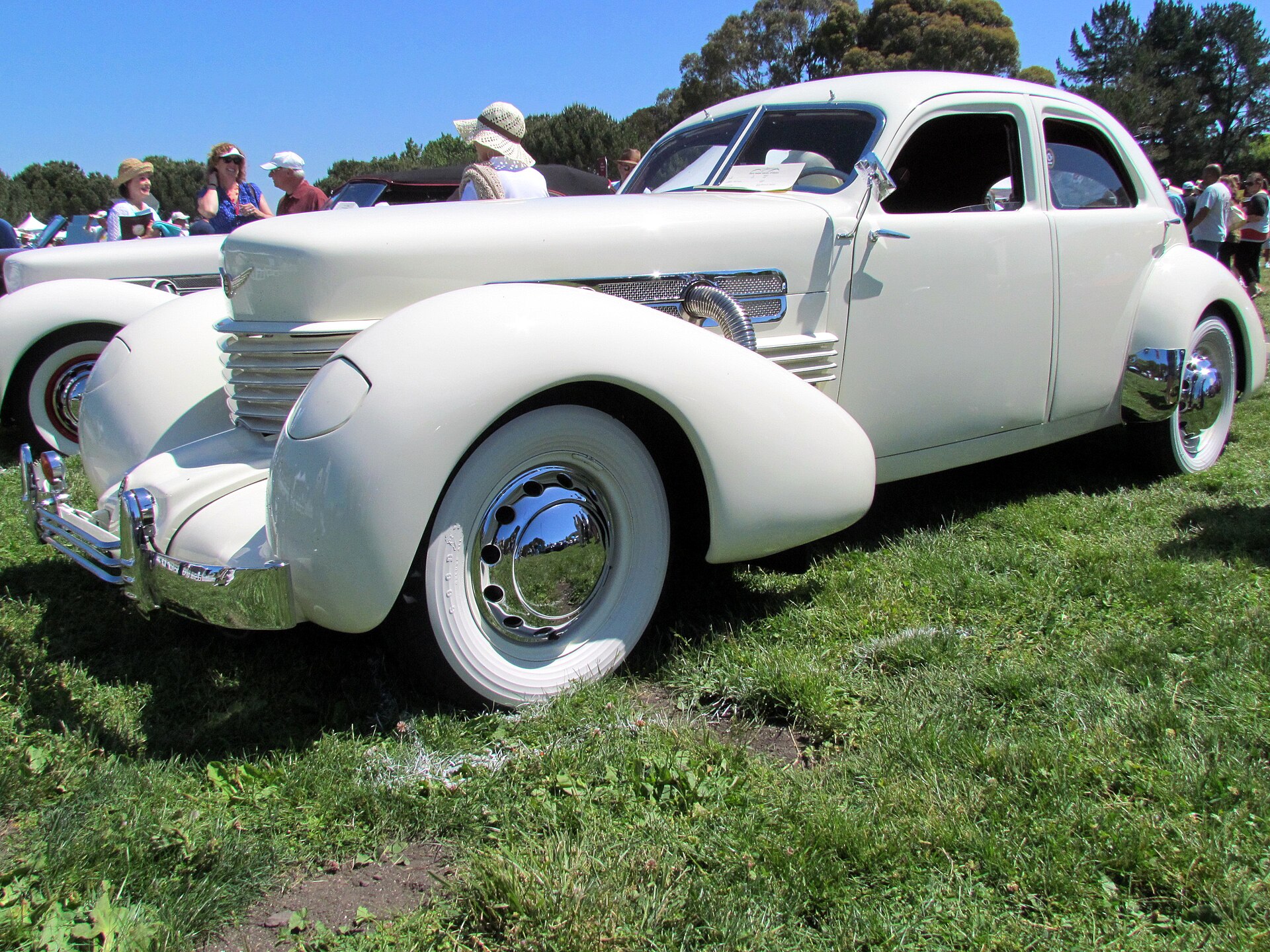
The nickname “coffin nose” captures the bonnet’s almost furniture-like shape. Where other manufacturers used an upright radiator as a focal point, Cord gave the car a low, architectural front end. The concealed headlights sat in the front wings and were raised using hand cranks inside the cabin. This was no electrically operated party piece, but a hands-on solution that required the driver’s involvement.
Front-wheel drive was crucial to the proportions. With no need to transmit power through a propshaft to the rear wheels, the floor and body could sit lower. Together with the chassis design, this made traditional running boards redundant. There was no longer any need to step up onto an intermediate platform to get in.
Cord had already used front-wheel drive in the L-29. With the 810 and 812, the technology gained a considerably more modern visual expression. What was unusual was how engineering and styling worked towards the same goal.
A V8 with two different temperaments
Under the bonnet sat a side-valve V8 from Lycoming, which, like Auburn, was part of E. L. Cord’s business empire. The engine was compact compared with the straight-eight still found in many American prestige cars. The gearbox was mounted ahead of the engine and drove the front wheels.
The standard engine made the 812 a lavish road car rather than an out-and-out sports car. For 1937, a centrifugal supercharger was also offered, forcing more air into the engine and increasing power. That version appealed to customers who wanted to combine the distinctive styling with greater performance.
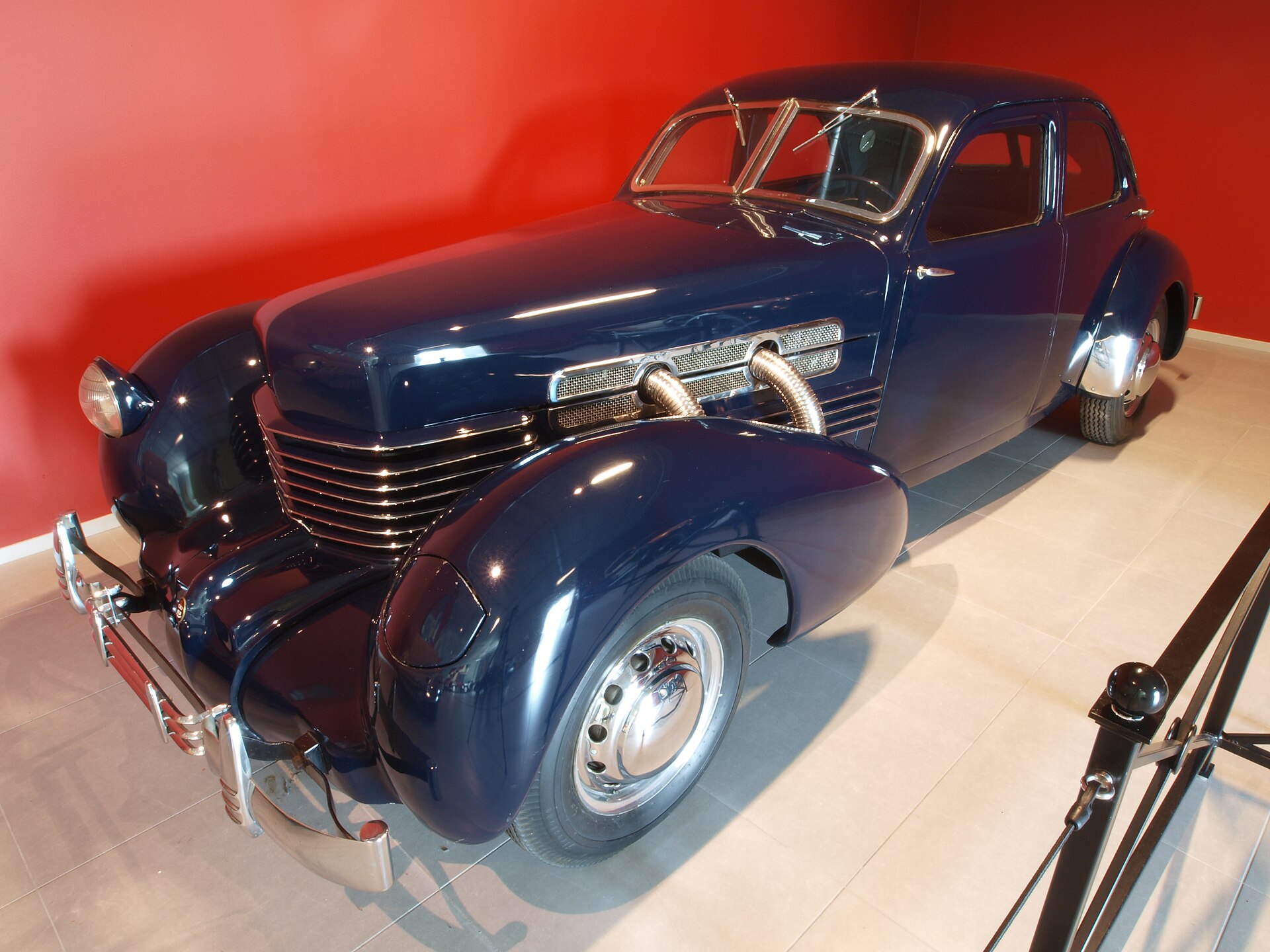
The external, metal-clad exhaust pipes along the sides of the bonnet became the supercharged cars’ most obvious identifying feature. But the pipes alone are no guarantee of authenticity on a car that may have been modified over almost nine decades. When buying, the engine specification and the car’s documentation must tally. A standard 812 should not automatically be described as supercharged simply because it wears these eye-catching details.
The next gear was selected in advance
The cabin continued the same technical ambition, with a comprehensively instrumented dashboard and a small gear selector beside the steering wheel. Cord used a four-speed preselector manual gearbox with electrical and vacuum-assisted operation.
The driver selected the desired gear in advance. The actual change then took place when the clutch pedal was depressed. It was not an automatic gearbox: using the clutch was still part of the process. The driver was, however, spared the task of moving a long floor-mounted lever through a conventional shift pattern.
The idea suited the luxury car’s brief: less manual effort and a tidier driving environment. The system depended on correct adjustment, and early problems, including those with the gearchange mechanism, damaged the model’s reputation. For today’s owners, functioning vacuum systems, electrical contacts and correctly adjusted mechanical components are therefore just as important as beautiful paintwork. The editorial team has not driven the car; its distinctive character is discussed here in terms of its engineering and intended use.
A short life, a long legacy
Production ceased in 1937 when Auburn stopped making cars. The Cord 812 was therefore not the beginning of a long model line, but the final chapter in a bold attempt to redefine the American luxury car.
Today, originality and documented restoration are central to its collector value. Body style, supercharged specification, history and mechanical condition can lead to large differences in price; any blanket valuation would be misleading. A properly restored gearchange mechanism can matter more to usability than fresh chrome.
That is also where the car’s appeal lies. The Cord 812 is not merely an unusual sight. It shows what happens when stylists and engineers dare to rethink things at the same time – and the workshop then has to make the future work.
Sources
- Gordon M. Buehrig och William S. Jackson, Rolling Sculpture: A Designer and His Work (1975)
- Beverly Rae Kimes och Henry Austin Clark Jr., Standard Catalog of American Cars 1805–1942 (1996)
- Auburn Cord Duesenberg Automobile Museum, Auburn Cord Duesenberg Automobile Museum
Ask questions about “Cord 812 – the luxury car that hid its headlights and broke the rules”. Answers are based on the magazine's own articles.