Autozam AZ-1: gullwings in miniature
Mazda’s tiny sports car took the limitations of the kei format as a challenge.
A mid-mounted engine, turbo power and gullwing doors – in a smaller footprint than a conventional supermini. The Autozam AZ-1 was launched in Japan in 1992, bringing together Mazda’s sports car ambitions and Suzuki’s small-car expertise in an unusual package. Today, it is a collector’s car whose door gas struts deserve almost as much attention as its engine.
 By Henrik SjöbergReporter · Special cars and classic cars
Translated from Swedish with the help of AI.
When small-car rules met big ideas
The 1992 Autozam AZ-1 is a two-seater Japanese sports car with a mid-mounted engine and gullwing doors. Mazda was behind the model, which was sold through the company’s Autozam network in Japan. Suzuki supplied the engine and had also worked on small mid-engined prototypes before Mazda took the project further. The result was not quite a small car with a sports package. More a sports car that someone had put through too hot a wash.
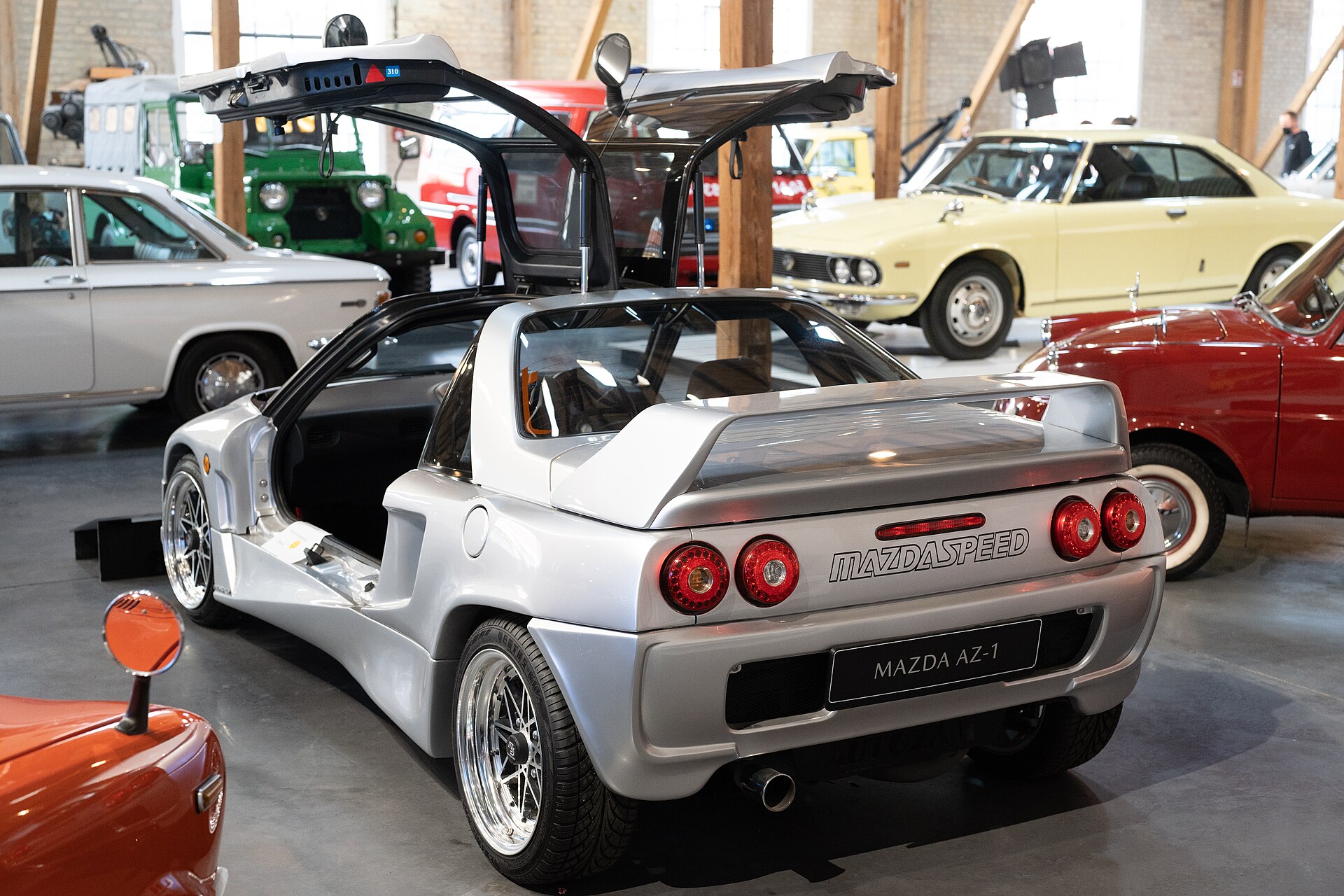
The explanation lies in Japan’s kei class, whose limits on dimensions and engine capacity gave small cars particular ownership advantages. At the time of launch, a kei car could be no more than 3.3 metres long and 1.4 metres wide, with an engine of no more than 660 cubic centimetres. The AZ-1 came in just within those limits. Its low height, however, was a choice of its own: the rules did not demand a miniature supercar.
The market also included the Honda Beat and Suzuki Cappuccino. All three showed that a small footprint could be put to uses beyond carrying shopping bags. But while its rivals offered open-top motoring, the AZ-1 opted for an enclosed cabin and doors that opened upwards. Anyone wanting to be noticed therefore had an option that did not involve buying a big car.
Mazda developed the design, Suzuki supplied the power
At the 1989 Tokyo Motor Show, Mazda displayed three small sports car concepts under the AZ-550 name. They explored different body styles; the production car developed the Type A, with its gullwing doors. It was a bold choice for a car that would be sold, serviced and used every day, rather than simply sit on a turntable.
Suzuki’s contribution was a turbocharged three-cylinder engine, mounted behind the seats and ahead of the rear axle. Power went to the rear wheels through a five-speed manual gearbox. This gave the AZ-1 a proper mid-engined layout, despite its engine capacity being smaller than that of many motorcycles. The Japanese power rating followed the kei manufacturers’ voluntary ceiling of 64 PS at the time.
The collaboration became even clearer in 1993, when Suzuki began selling its own version, the Cara. It was fundamentally the same car, with some differences in details and equipment. The AZ-1 is therefore neither a Mazda invention alone nor simply a Suzuki with a different badge: its development history ties the two companies together.
The engine’s position left no room for a rear seat. Here, two people, low weight and the basic sports car philosophy took priority over a small car’s usual task of accommodating as much as possible. Luggage had to fit around the car, not the other way round.
Plastic outside, steel underneath
The body consisted of plastic panels over a load-bearing steel structure. The outer panels gave the car its shape, while the steel provided its fundamental strength. That construction still matters today: a gleaming, crack-free exterior does not mean the car is free of rust beneath the skin.
The styling borrowed the most recognisable sports car cues: a low nose, air intakes behind the doors and a cabin that looks tucked between the wheels. The extensive glazing, including in the upper sections of the doors, reinforced the almost concept-car-like impression. The AZ-1 still looked like a motor show exhibit once it had gained number plates.
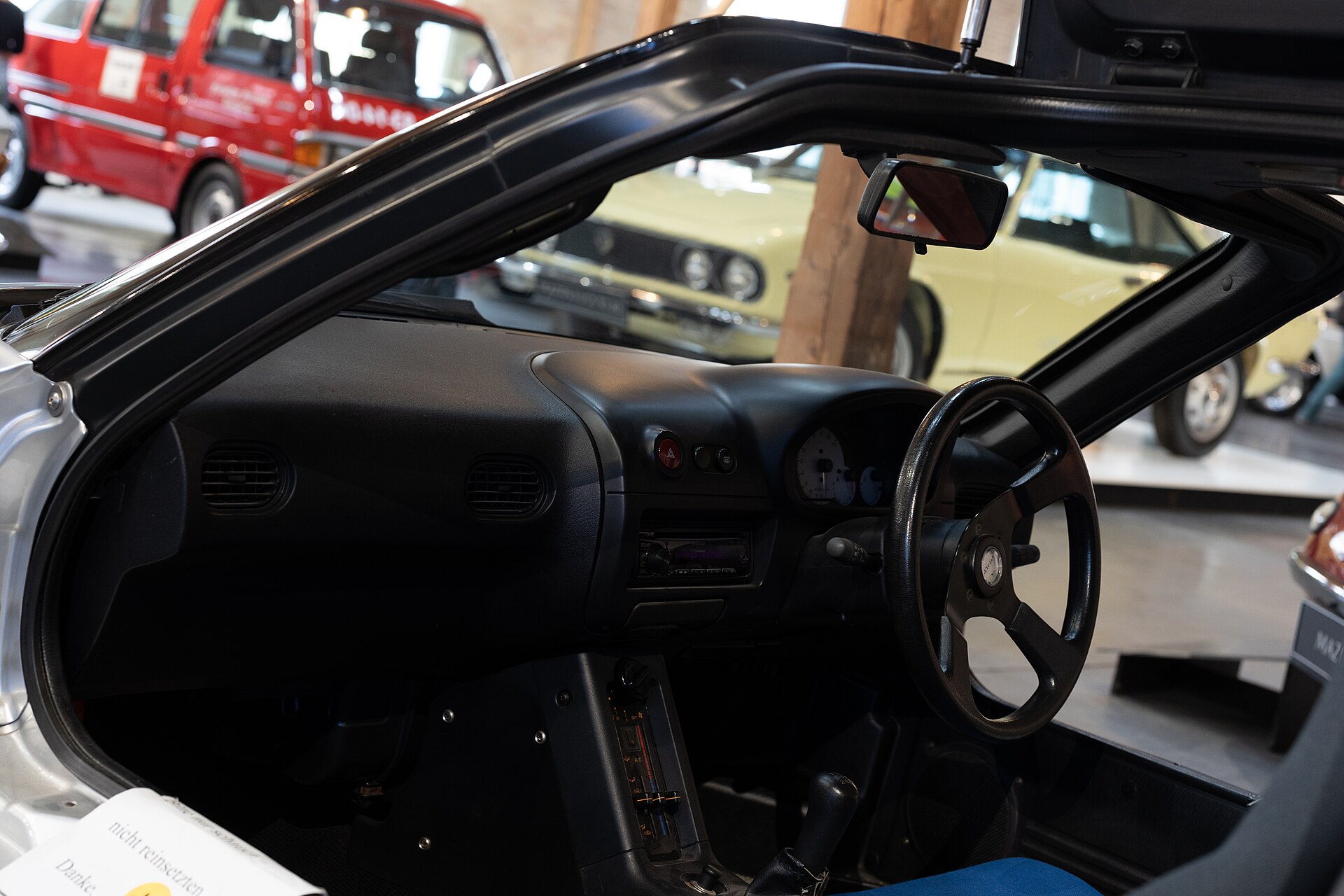
The doors, however, did not add any cabin width. Inside were two closely spaced seats, a simple instrument layout and limited room for both occupants and odds and ends. The side windows had small opening sections rather than large panes that could be wound down. Most of the theatre was on the outside.
For a prospective buyer, a proper trial in the driving seat is therefore more useful than yet another photograph of the doors open. Try getting in, close the door and check the space for your head, knees and feet. Fitting inside is not quite the same as being able to use the car comfortably.
A collector’s car with a particular buying checklist
The AZ-1 was no sales-volume success, but its combination of unusual construction and strong personality has earned it collector status. Availability in Sweden is limited, and value depends on condition, originality, documentation and access to the right parts. Gullwing doors come with no guarantee of rising prices.
Start the pre-purchase inspection underneath the car: examine the steel structure, sills, floor and mounting points for rust or previous repairs. Then check the plastic panels for cracks, fit and secure mountings. Model-specific body parts and glass can be harder to source than routine service parts.
Finally, open both doors several times. The gas struts should hold them up, the hinges and locks should work without play, and the seals should be checked for leaks. A Swedish buyer importing one must also check the paperwork and the requirements for a registration inspection. After all, the most charming car is one you can actually use – and whose door does not need to be held up with your head.
Sources
- Mazda, japansk försäljningsbroschyr, Autozam AZ-1 (1992)
- Suzuki, japansk försäljningsbroschyr, Suzuki Cara (1993)
- Lane Motor Museum, Autozam AZ-1 – 1992
Ask questions about “Autozam AZ-1: gullwings in miniature”. Answers are based on the magazine's own articles.