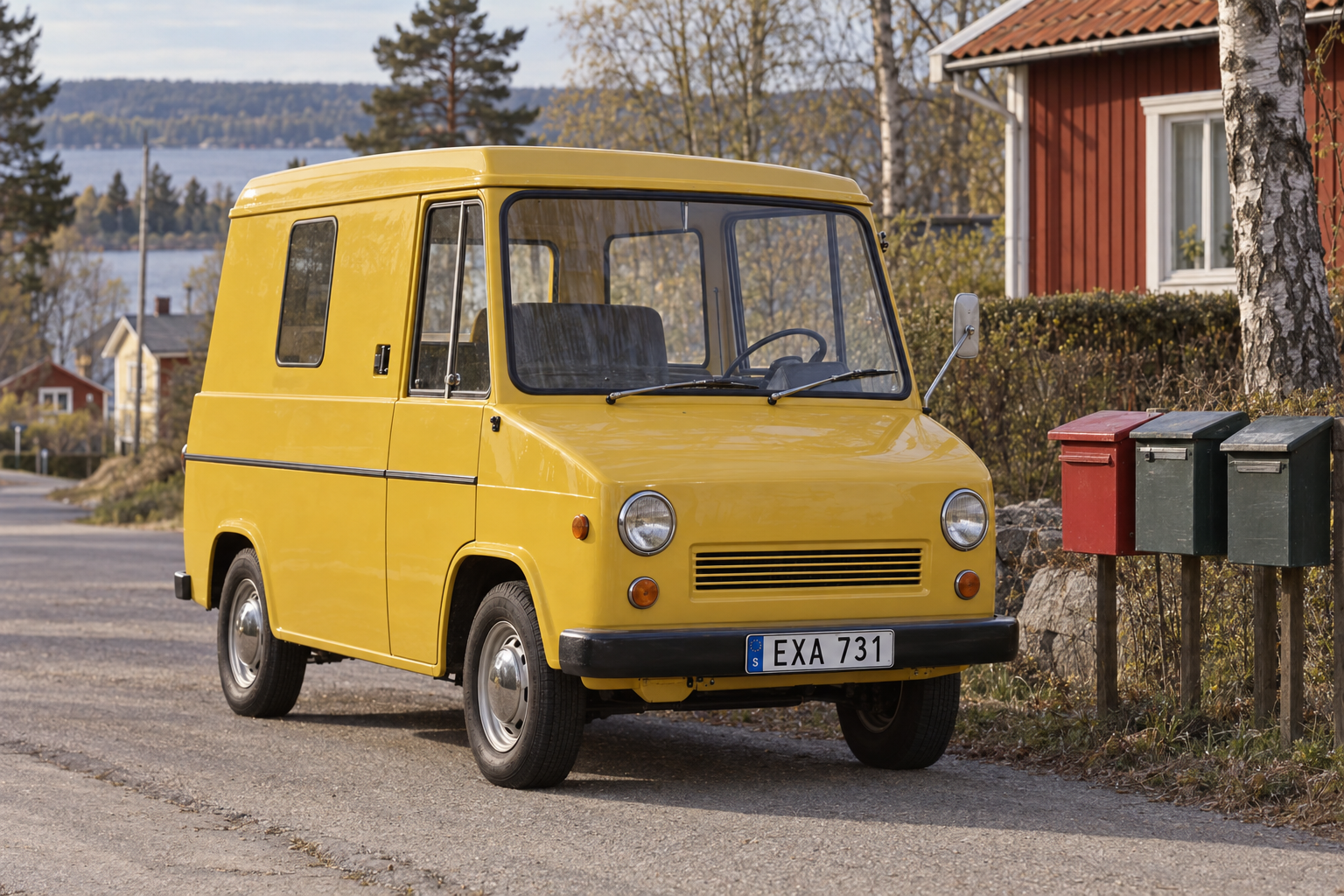
Tjorven – the Mail Truck That Thought Outside the Box
DAF technology under a Swedish plastic body
Tjorven looked like a package on wheels, but its shape served a clear purpose. With a Dutch drivetrain, a Swedish plastic body, and the mail carrier’s workday as its yardstick, this Kalmar-built vehicle became one of Sweden’s most distinctive commercial vehicles.
 By Henrik SjöbergReporter · Special cars and classic cars
Translated from Swedish with the help of AI.
A Vehicle Built Around the Mailbag
The Kalmar KVD 440, better known as Tjorven, was a small Swedish delivery vehicle produced in series from 1969–1971. Its manufacturer was Kalmar Verkstad, a company with much deeper roots in railroad workshops than in the passenger-car world. The assignment here was not to entice car buyers with long hoods. It was to give mail carriers a practical tool for the job.
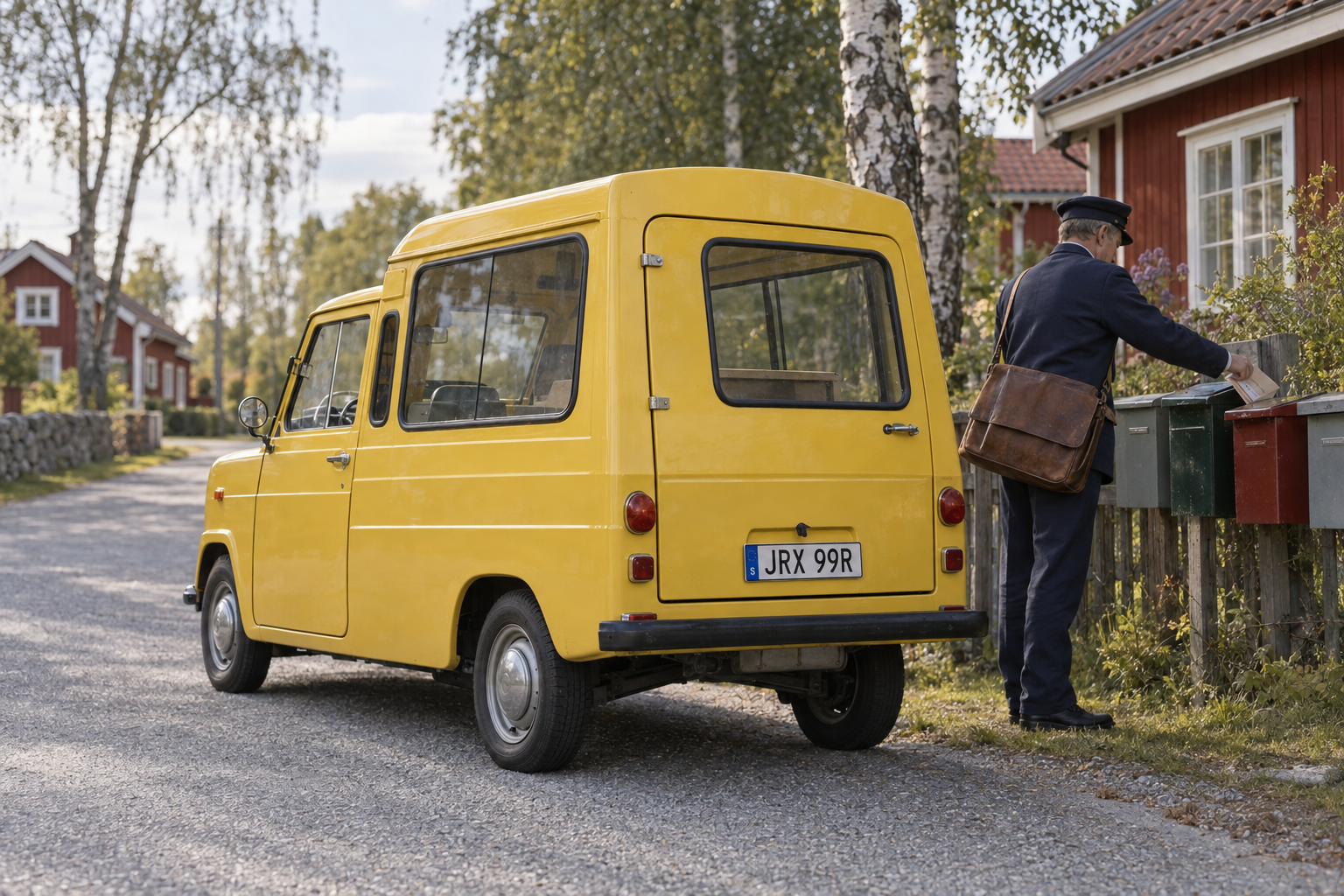
The postal service needed a vehicle for frequent stops, tight passages, and roadside deliveries. A conventional passenger car could carry letters, of course, but its doors, seats, and trunk were not designed for that particular job. Tjorven reversed the thinking: first the task, then the vehicle.
The nickname referred to Tjorven in Astrid Lindgren’s Saltkråkan. It certainly suited a small, rather chubby vehicle with a big personality. The formal designation KVD 440 would hardly have earned the same place in the public memory. But behind the friendly name was a serious attempt to streamline a workday in which every unnecessary movement was repeated many times.
This is the model’s history, not a profile of a particular museum or collector example. There is therefore no individual chassis number or state of restoration to report. The distinction matters: surviving Tjorvens may have been modified during both their working lives and their retirement.
Dutch Technology in a Swedish Package
Developing a proprietary engine and transmission for a small production run of mail trucks would have been an expensive way to reinvent the wheel. Instead, Kalmar Verkstad used the engine and drivetrain from the DAF 44. The Dutch small car’s air-cooled flat-twin engine and continuously variable Variomatic thus found themselves doing a very different job from family outings.
Variomatic used belts and pulleys with variable effective diameters to change the drive ratio. The driver had no clutch pedal to operate and no manual gear changes to make. In a delivery vehicle, that was more than a convenience: with constant starts and stops, there was a clear advantage to not having to shift over and over again.
Air cooling also meant the engine had no conventional water-cooling system with a radiator. That did not, however, make the vehicle maintenance-free. The belt drive, engine, and other mechanical components still required attention. Tjorven was a working tool, not a technological magic wand in yellow paint.
Nor should the DAF connection be taken to mean that Tjorven was merely a rebodied passenger car. The body and working environment were designed specifically for delivery duties. The result was a distinct Swedish vehicle with familiar technology beneath the skin—a fairly sensible division of labor for a small manufacturer.
Boxy for Good Reason
The body was made of fiberglass-reinforced plastic. The material suited small-scale production, where large stamping dies for sheet steel could otherwise be a major expense. It also provided the freedom to create the tall, box-shaped body without having to borrow a passenger car’s silhouette.
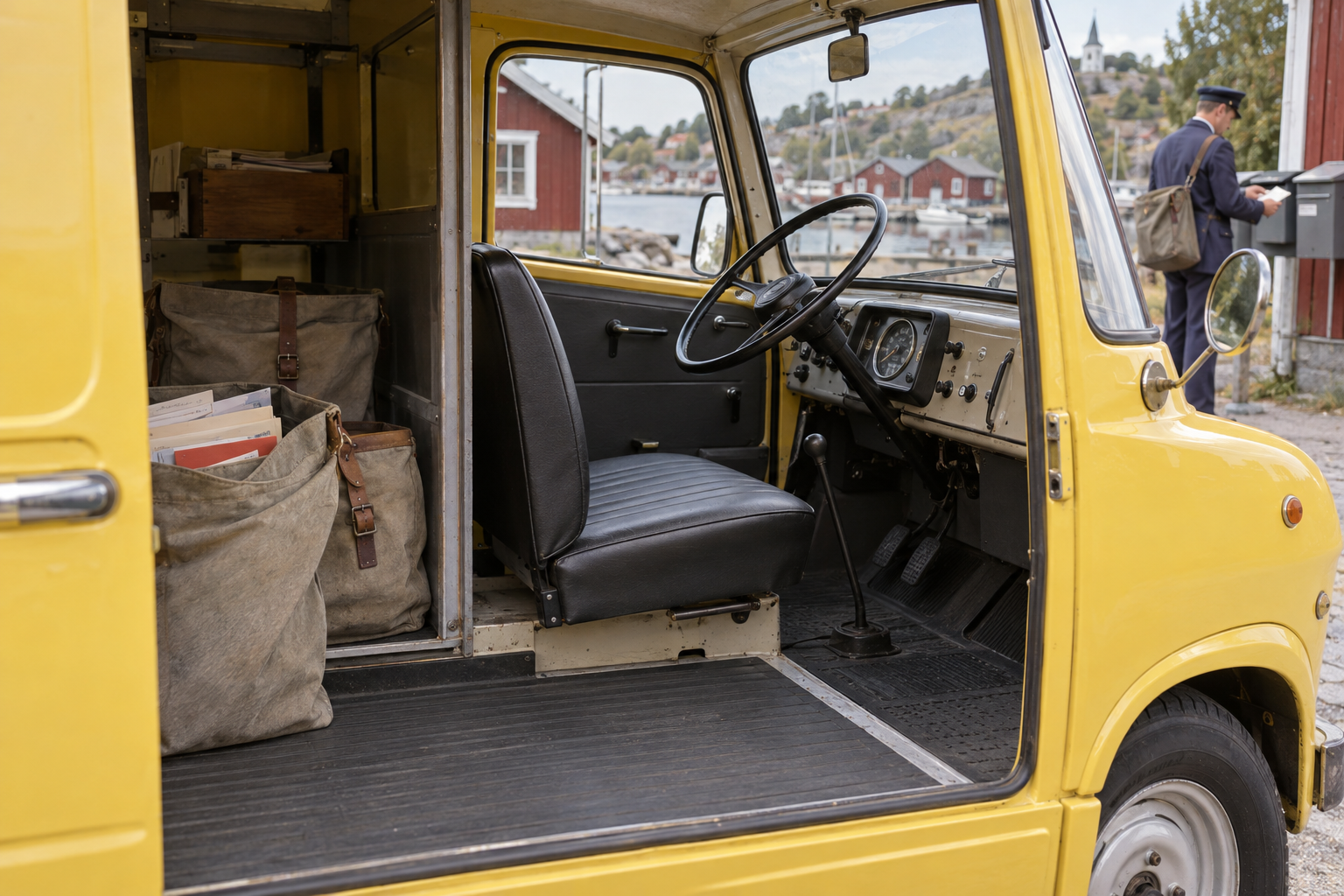
The large windows and upright shape were tied to the job. The driver needed good visibility, while the cargo needed usable space rather than elegantly sloping lines. Tjorven therefore looks less like a conventional van in miniature and more like a small workspace on wheels.
The postal version’s right-hand driving position was particularly well considered following Sweden’s switch to driving on the right. It placed the mail carrier close to the roadside and the mailboxes. The sliding-door arrangement also reduced the clearance needed outside the vehicle compared with an outward-swinging door. Small design choices, with a big impact when the same actions were repeated all day.
We have not test-driven the vehicle. Its intended use is clear, however: an easily accessible driving position, an easy-to-operate drivetrain, and room for the day’s mail. The workflow was supposed to impress, not the acceleration on the way home.
From Work Vehicle to Collector Vehicle
Production was short-lived, and Tjorven remained an unusual vehicle rather than the beginning of a major Swedish commercial-vehicle brand. It is precisely this combination of postal history, local industry, and unusual technology that makes it interesting today. It tells the story of a Sweden where even an everyday delivery problem could be answered with a vehicle model all its own.
For a buyer, condition matters more than the charming name. The plastic body does not rust like sheet steel, but it can crack and may have old repairs. The metal components underneath must also be inspected. The DAF connection helps when identifying mechanical components, while model-specific body parts can be considerably trickier to find.
The original interior, correct door arrangements, and documented service history are worth examining. No reliable general price range is given here; few sales and wide variations in condition make comparisons uncertain. The best Tjorven is not automatically the shiniest, but the one whose history and restoration can be understood.
Sources
- Nick Georgano (red.), The Beaulieu Encyclopedia of the Automobile (2000)
- Postmuseum, Postmuseum
- DAF Museum, DAF Museum
Ask questions about “Tjorven – the Mail Truck That Thought Outside the Box”. Answers are based on the magazine's own articles.