Saab Sonett II – the sports car that got a bulge in the bargain
From two-stroke lightweight to Ford V4 in Arlöv
The Saab Sonett II started out as a small sports car with a two-stroke engine and a fiberglass body. Then came the V4 engine, and the hood had to adapt. The story of the Saab 97 is about how much sports car could be built from familiar Saab hardware—and how tricky it was to make the business case work.
 By Henrik SjöbergReporter · Special cars and classic cars
Translated from Swedish with the help of AI.
A Saab with different intentions
The Saab Sonett II, internally designated Saab 97, was introduced in 1966. It was a two-seat sports coupe with a fiberglass body, front-wheel drive, and initially Saab’s three-cylinder two-stroke engine. Production took place at ASJ, AB Svenska Järnvägsverkstäderna, in Arlöv. Here, the industrial expertise of a railroad workshop met the idea of a small Swedish sports car. A roomy family car was never on the agenda.
Saab had already used the name on the open-top Sonett of 1956, later called the Sonett I. The new car, however, was intended for series production, not merely as a technical experiment. The US was especially appealing: small European sports cars had an established following there, and Saab’s dealers could use something extra in the showroom window.
The route to production led through two competing prototypes: Malmö Flygindustri’s MFI-13 and Sixten Sason’s Catherina. It was the MFI approach that moved forward. Björn Karlström was responsible for the basic shape, while development of the production version brought further revisions. The Sonett II was therefore not just a regular Saab with its roof pushed down; the project had its own origins and a distinctly specialty-car character.
Fiberglass, a low nose, and a big hood
The body was made of fiberglass-reinforced plastic and mounted on a load-bearing steel chassis. For a small production run, that was an important combination: the plastic body did not require the same stamping dies as a conventional steel body. Mechanical components, meanwhile, could be drawn from Saab’s existing model lineup. The sports car dream still had to get along with the economics of the shop floor.
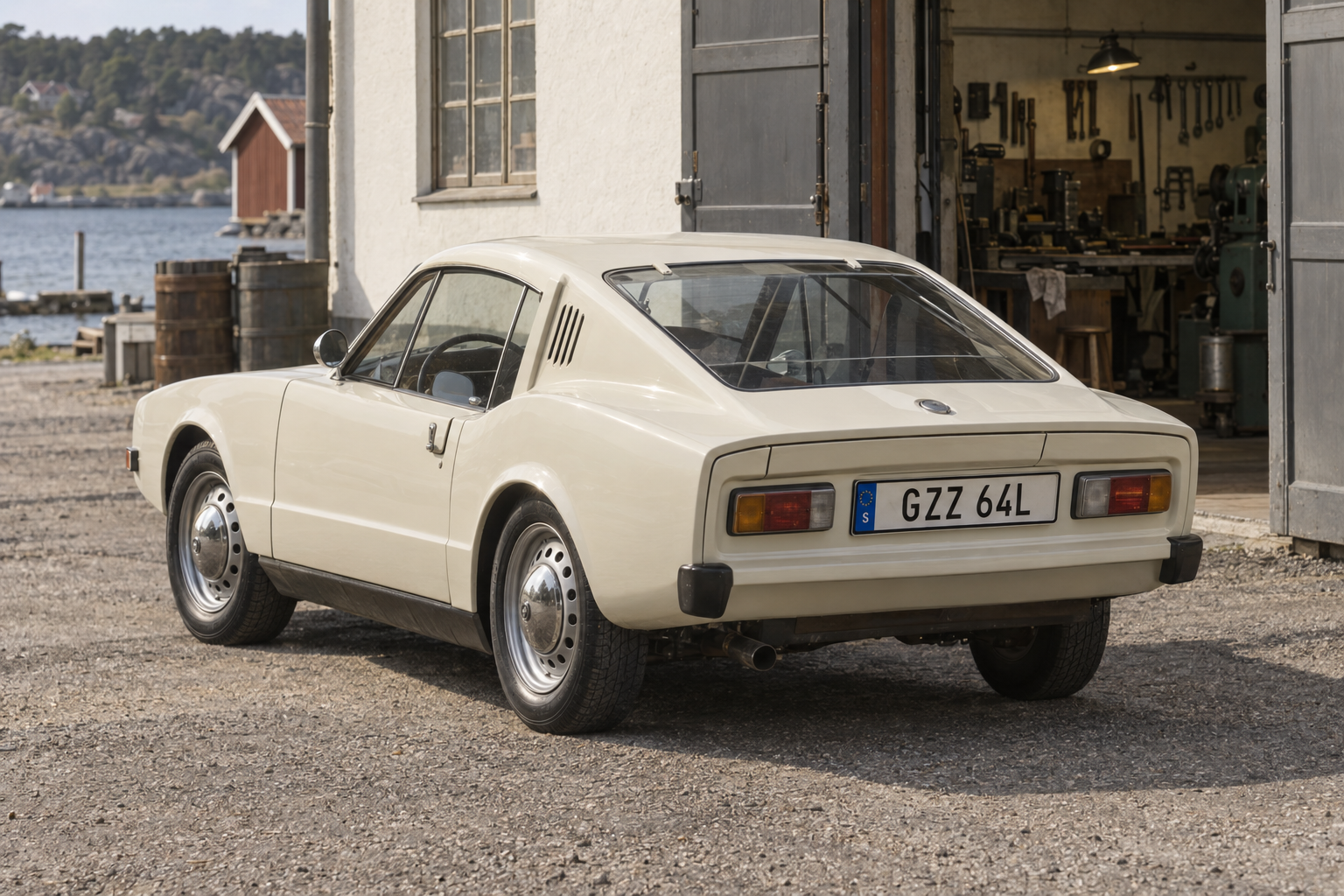
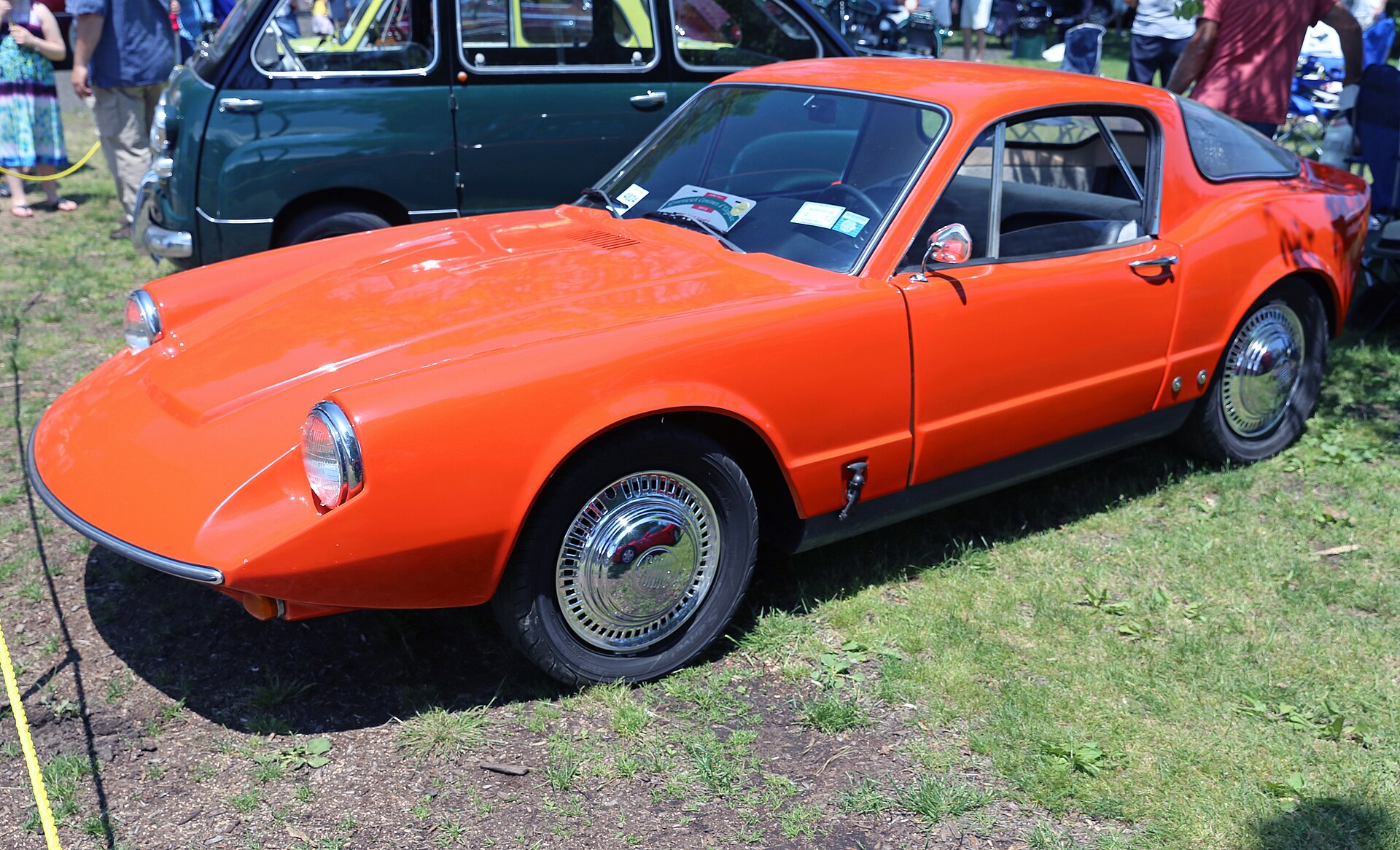
The shape was compact and quite distinctive. The round headlights sat beneath clear covers, the cabin was narrow, and the rear end was short. The entire front section could tilt forward to provide access to the engine and front suspension. It is a detail that both looks race-inspired and has a very practical everyday benefit when something needs to be unbolted.
Inside, there was room for two, with the seats close together and the instruments grouped in front of the driver. Gears were selected with a column shifter, a clear sign of kinship with the more practical Saab models. Anyone expecting every detail to follow British or Italian sports car convention had to think again. The Sonett was built around Saab’s solutions, not some universal rulebook for what a sports car should look like.
When the two-stroke had to make way
The first version used a tuned version of Saab’s two-stroke engine. With its low vehicle weight and compact powertrain, it suited the basic concept well. But during the same period, Saab’s regular passenger cars were moving toward four-stroke power, and the Sonett followed suit.
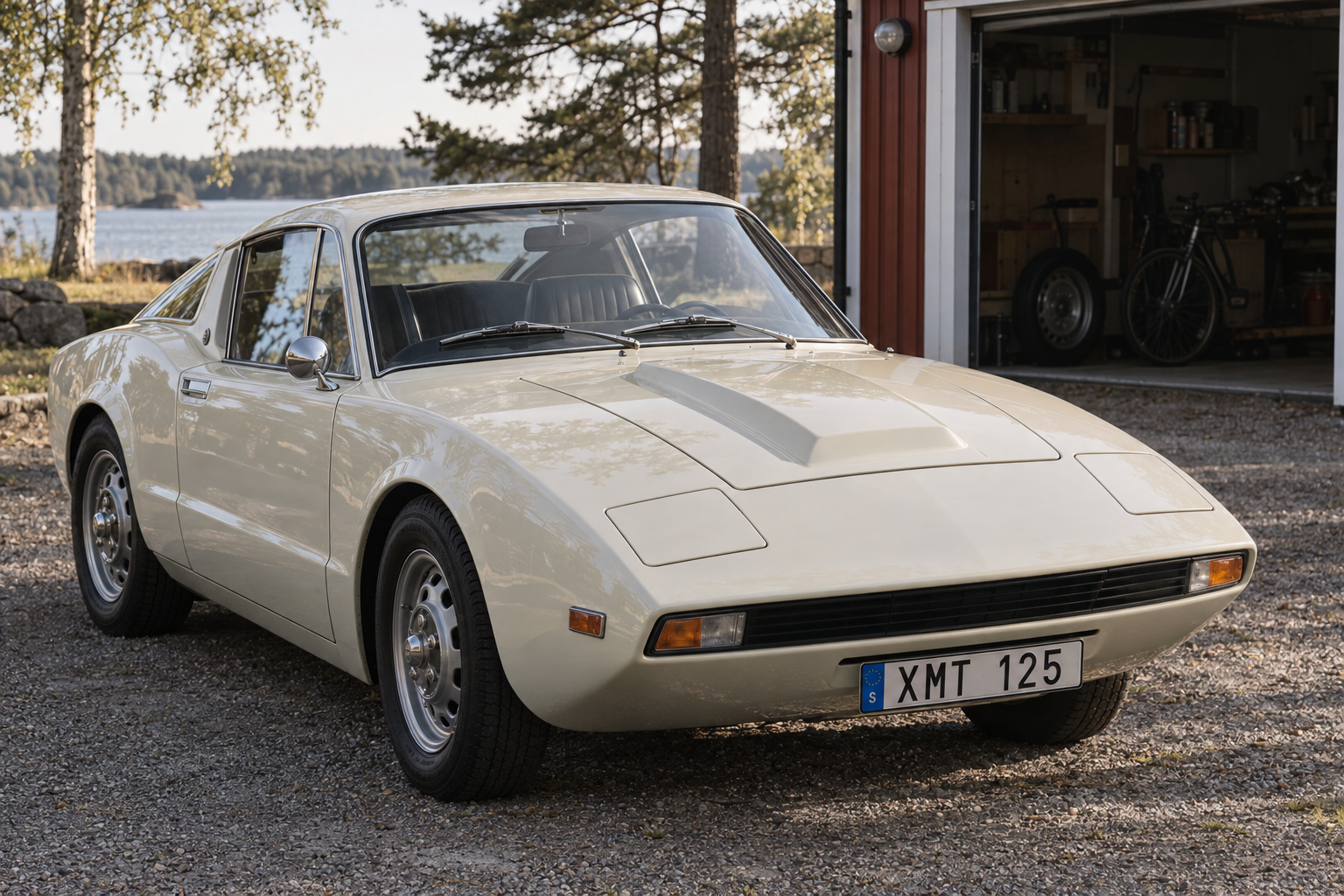
The Sonett V4 arrived during 1967, still within the Saab 97 model family. It received the Ford-built V4 engine also used in the Saab 95 and 96. That tied the sports car more closely to the technology Saab was now investing in for its higher-volume models. The change was therefore about more than simply getting a different engine character.
The new engine needed more vertical space. The solution was the conspicuous hood bulge, the easiest way to distinguish the V4 version from the earlier two-stroke. The car literally had to tailor its suit to fit what was inside. It was hardly a discreet alteration, but the detail makes unusually clear what lies under the hood.
The Sonett was intended as a small road-going sports car for two, not a family long-distance cruiser. Front-wheel drive set it apart from many contemporary rivals, while low weight was central to its performance. This description is based on the design and intended use; the editorial team has not test-driven the car.
A small production run, big questions when buying
A total of 258 two-stroke Sonett II models and 1,610 Sonett V4 models were built. Production of this body generation ended in 1969, before the Sonett III took over in 1970. That makes the two-stroke especially rare, but rarity is not the same thing as a guaranteed market value.
For a collector, identity and condition matter more than shiny paint. Check the chassis number, documentation, and whether the engine variant and body configuration match the car’s history. Fiberglass does not rust, but the steel chassis beneath it can. Older body repairs, cracks, and missing model-specific parts also deserve careful scrutiny.
A well-documented restoration can therefore carry considerable weight. Any blanket price figure can easily be misleading for such small production runs: originality, completeness, and the work performed can vary greatly from one example to another. The Sonett’s charm lies precisely in its blend of familiar Saab mechanicals and an unusual low-volume body. The former makes ownership easier; the latter demands patience.
Sources
- Saab Car Museum, Saab Car Museum
- Björn-Eric Lindh, Saab: The First 40 Years (1987)
- Nick Georgano (red.), The Beaulieu Encyclopedia of the Automobile (2000)
Ask questions about “Saab Sonett II – the sports car that got a bulge in the bargain”. Answers are based on the magazine's own articles.