Lancia Delta Evoluzione – Rally Heritage in Its Widest Form
The first Evoluzione made the Integrale wider, more purposeful, and even more closely tied to rallying.
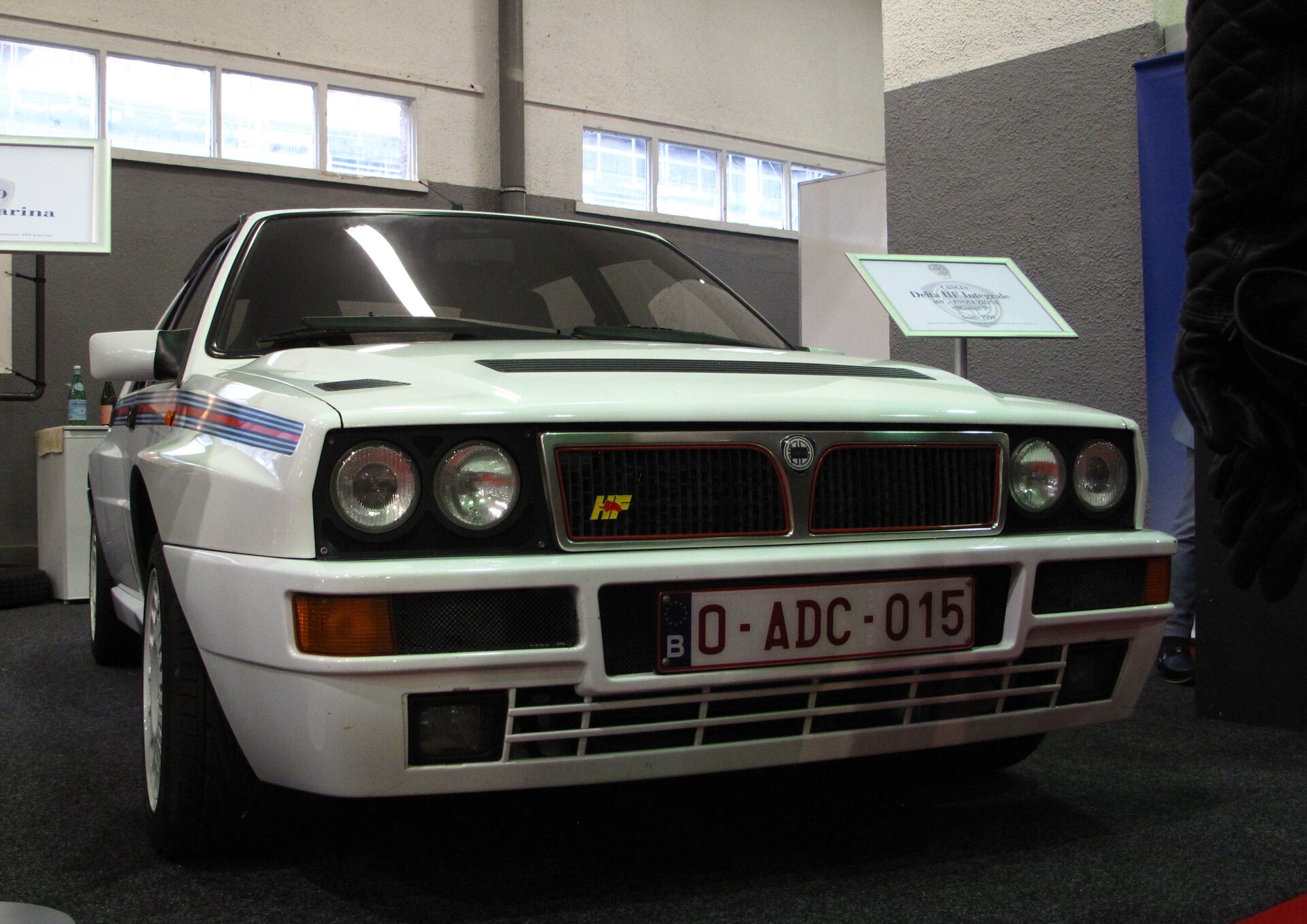
The fenders bulge, the hood rises, and the rear wing signals serious intent. The 1991–1992 Lancia Delta HF Integrale Evoluzione turned an angular family car into a concentrated dose of rally technology—with more substantial changes beneath the skin than its appearance initially reveals.
 By Nora LindqvistReporter · Sports cars and motorsports
Translated from Swedish with the help of AI.
From Family Car to World Championship Weapon
The Lancia Delta HF Integrale Evoluzione debuted in the fall of 1991, and its first version was produced during 1991–1992. The Evo I designation is often used to distinguish it from the Evoluzione II, which arrived in 1993. Here, the focus is on the first version, without a catalytic converter in standard European specification, with a turbocharged two-liter engine and permanent all-wheel drive.
The starting point was still Giorgetto Giugiaro's five-door Delta, launched in 1979: straight lines, a large glass area, and a practical hatchback body. The Evoluzione was not a standalone sports car borrowing a model name. It retained the family car's basic layout, but its body had been adapted for considerably harder work.
The path there led through the Delta HF 4WD, Integrale, and Integrale 16V. All-wheel drive gave Lancia a competitive tool when Group A became the World Rally Championship's main class in 1987. The Delta family then won the manufacturers' championship six years in a row, 1987–1992. That is the entire model family's streak, not six titles for the Evoluzione.
The final title was won with the Evoluzione as the basis for the competition car. Lancia's direct factory effort had ended by then, and operations continued through Jolly Club with ongoing support from Lancia. The road car provided the basis for homologation: its engineering laid the groundwork for the further-developed rally car.
The Width Had a Job to Do
Compared with the Integrale 16V, the Evoluzione gained wider front and rear tracks, along with revised suspension. The enormous fender flares made room for the wider stance. The shape was therefore more than a signal to the outside world; it followed a concrete chassis change.
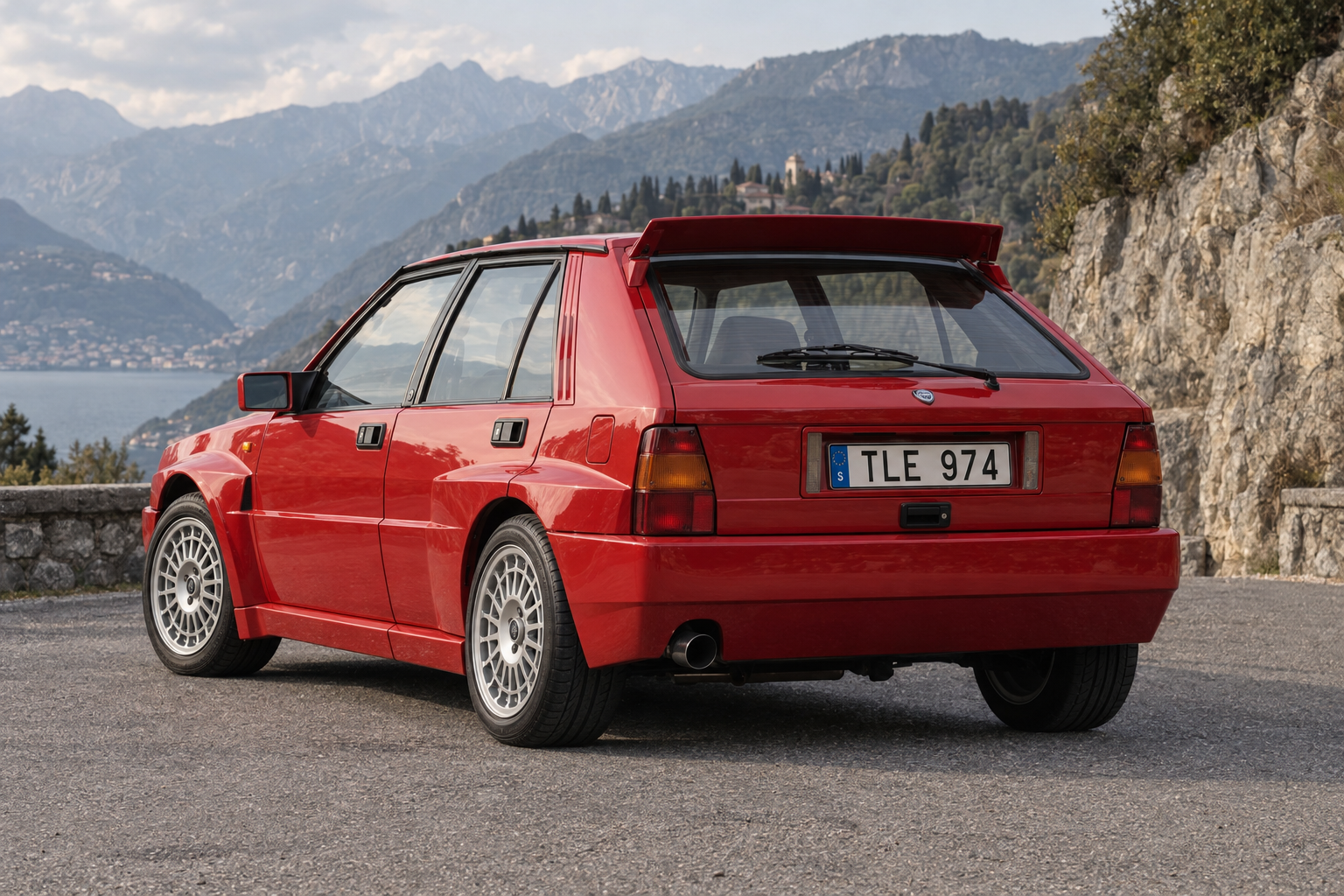
A wider track can reduce lateral load transfer under a given cornering load. That helps the tires share the work more evenly, although the result also depends on the suspension, roll stiffness, and tires. For the rally operation, the wider basic design also meant greater scope to develop the suspension within the regulations.
The hood's raised section and vents give the front end its characteristic heft. The vents help manage heat from the tightly packed engine compartment. Above the rear window sits an adjustable spoiler, intended to influence airflow and the car's aerodynamic balance. No substantiated downforce figures for the road car are given here.
The braking system was also upgraded, with four-piston front calipers. Vented front discs dissipate heat during repeated braking, while fixed multi-piston calipers provide a rigid structure around the pads. The standard wheels were still 15 inches—an important detail when distinguishing an early Evoluzione from later versions and modified examples.
More Than Ten Extra Horsepower
The transverse four-cylinder engine retained the Integrale 16V's basic recipe: two liters, dual overhead camshafts, four valves per cylinder, and a turbocharger with an intercooler. Output rose from 200 to 210 metric horsepower. The increase was modest; the Evoluzione's major advance lay in the combination of engine, chassis, cooling, and brakes.
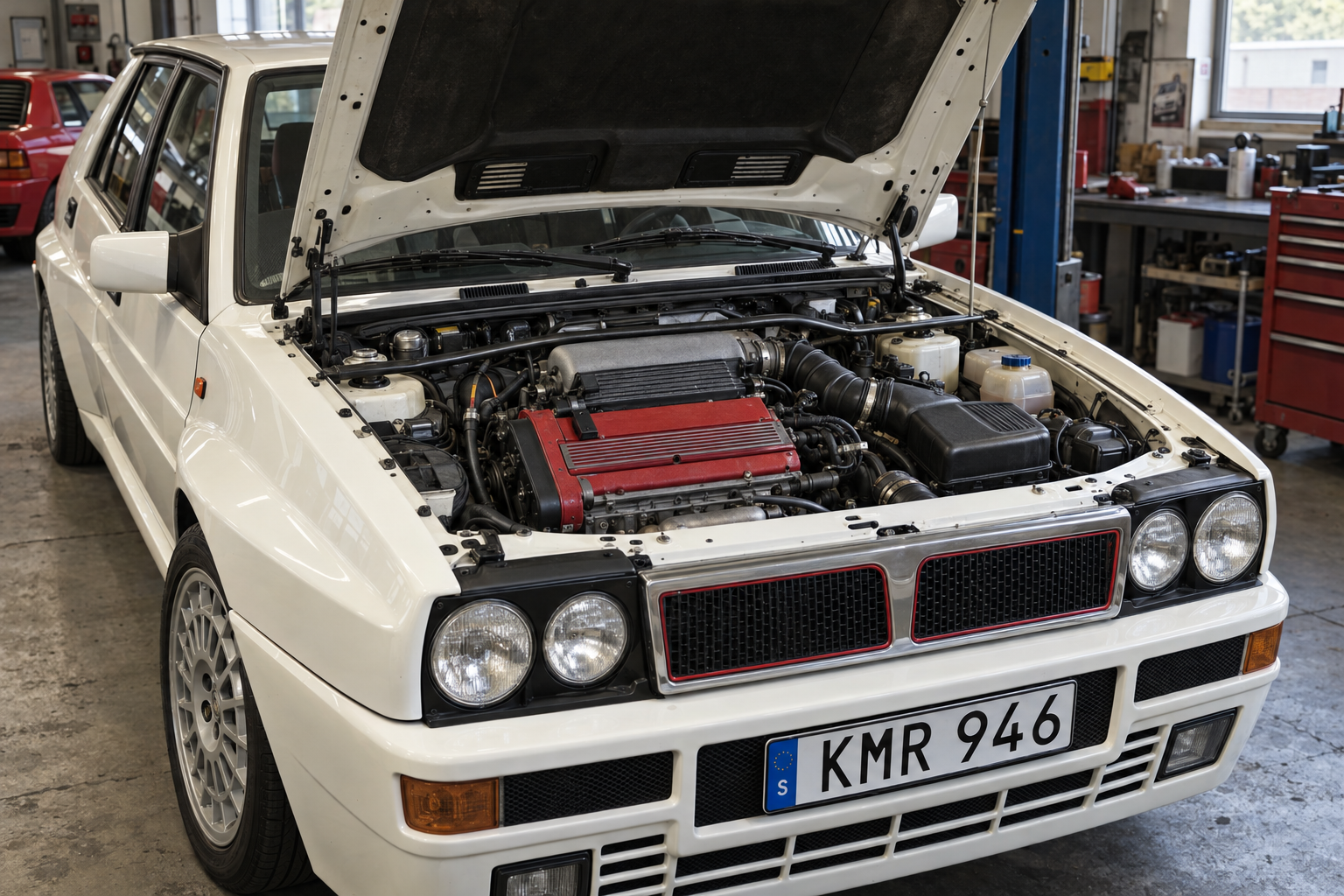
The turbo forces more air into the engine, while the intercooler lowers the temperature of the compressed air. This allows a greater mass of air into the cylinders, but also places demands on fuel delivery, temperature control, and lubrication. On an old Integrale, well-maintained supporting components are therefore just as important as the engine block itself.
A five-speed manual transmission distributes power through permanent all-wheel drive. The default split is 47 percent front and 53 percent rear. The center differential's viscous coupling limits rotational speed differences between the axles, and a rear Torsen differential helps distribute driving force between the rear wheels. The system lacks today's electronic torque management but gives the car several mechanical tools for making use of available grip.
The cabin still reveals its kinship with the everyday car: an upright dashboard, plenty of gauges, and a usable rear seat. The deeply bolstered front seats are the most immediate reminder of another intended use.
Driving and Life as a Collectible
The editorial team has not test-driven the car. Its engineering, however, clearly describes its intent: strong acceleration between corners, traction on varied surfaces, and brakes sized for repeated use. All-wheel drive helps the car accelerate, but it does not cancel out the tires' limitations under braking.
As a collectible, the Evoluzione should be judged on identity and condition before shine. Check the chassis number, documented specification, and any changes to engine management, boost pressure, and suspension. Original parts and a traceable service history carry considerable weight; a documented restoration is more valuable than unsubstantiated claims of original condition.
Have a specialist familiar with the model inspect for rust around the rocker panels, wheel arches, floor, and window frames, as well as repairs around mounting points. Ask for evidence of timing belt service, and check the turbo, cooling system, transmission, and differentials. Uneven panel gaps, cracks, and abnormal tire wear may warrant a closer investigation for hard use or accidents. Above all, the widest Delta deserves a narrow shortlist: the right example, not just the right badge.
Sources
- Stellantis Heritage, Lancia Delta HF Integrale
- Graham Robson, Lancia Delta 4x4/Integrale (2010)
- Peter Collins, Lancia Delta HF Integrale: The Story of a Champion (2003)
Ask questions about “Lancia Delta Evoluzione – Rally Heritage in Its Widest Form”. Answers are based on the magazine's own articles.