Saab Sonett II – the sports car that gained a bulge in the bargain
From two-stroke lightweight to Ford V4 in Arlöv
The Saab Sonett II began as a small sports car with a two-stroke engine and a fibreglass body. Then came the V4 engine, and the bonnet had to adapt. The story of the Saab 97 is about how much of a sports car could be built from familiar Saab engineering – and how tricky it was to make the business case stack up.
 By Henrik SjöbergReporter · Special cars and classic cars
Translated from Swedish with the help of AI.
A Saab with different intentions
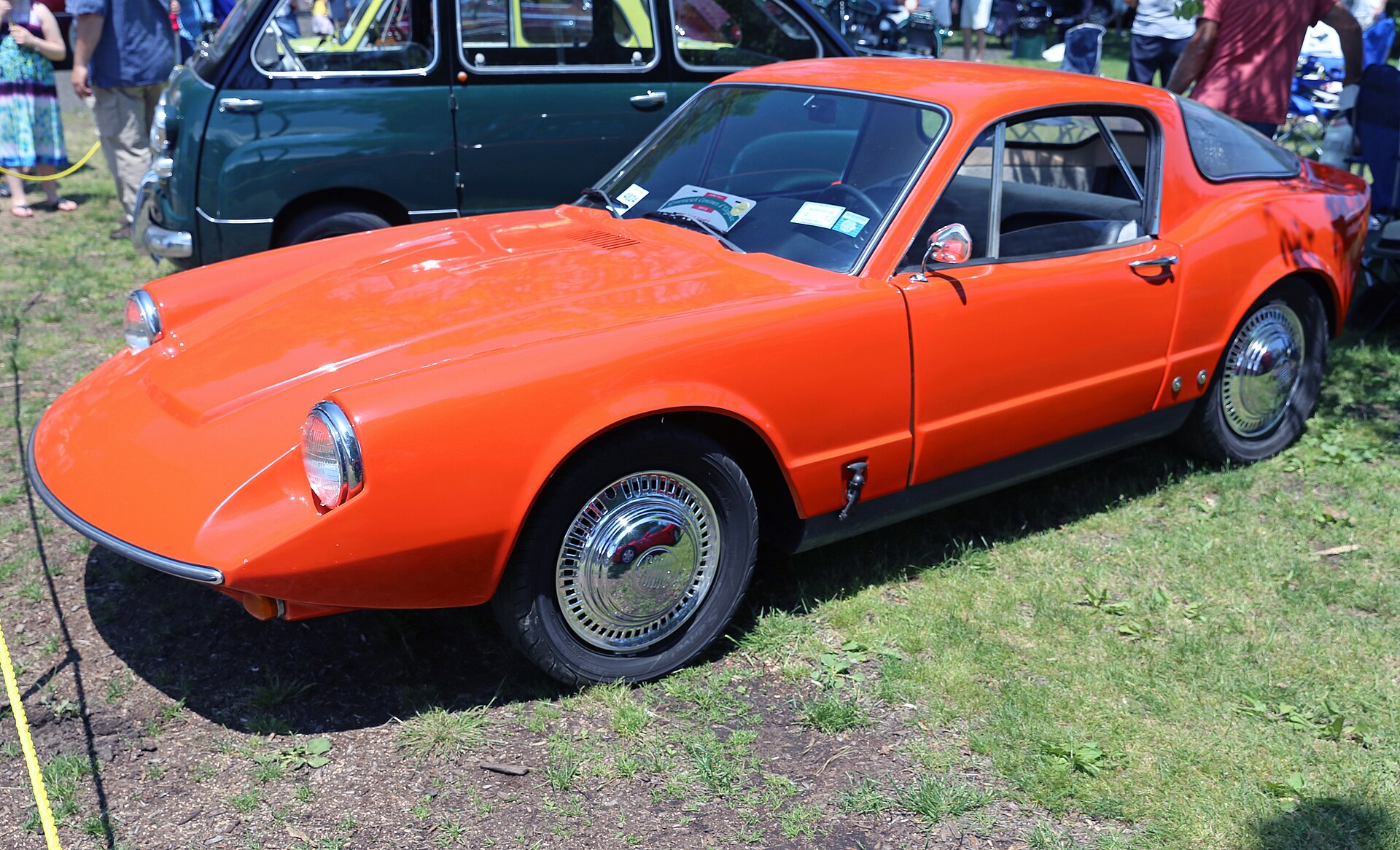
The Saab Sonett II, internally designated Saab 97, was unveiled in 1966. It was a two-seat sports coupé with a fibreglass body, front-wheel drive and, initially, Saab’s three-cylinder two-stroke engine. Production took place at ASJ, AB Svenska Järnvägsverkstäderna, in Arlöv. Here, then, the industrial expertise of a railway works met the idea of a small Swedish sports car. A spacious family car it was not going to be.
Saab had already used the name on the open-top Sonett of 1956, later called the Sonett I. The new car, however, was intended for series production, rather than merely as a technical experiment. The USA was particularly appealing: small European sports cars had an established following there, and Saab’s dealers could use something extra in the showroom window.
The route to production involved two competing prototypes: Malmö Flygindustri’s MFI-13 and Sixten Sason’s Catherina. It was the MFI approach that was taken forward. Björn Karlström was responsible for the basic shape, while developing the production version involved further refinement. The Sonett II was therefore not simply an ordinary Saab with its roof pushed down; the project had its own origins and a distinctly specialist character.
Fibreglass, a low nose and a large bonnet
The body was made from glassfibre-reinforced plastic and mounted on a load-bearing steel chassis. For a small production run, this was an important combination: the plastic body did not require the same press tooling as a conventional steel body. Meanwhile, mechanical components could be drawn from Saab’s existing model range. The sports car dream still had to live within the realities of manufacturing costs.
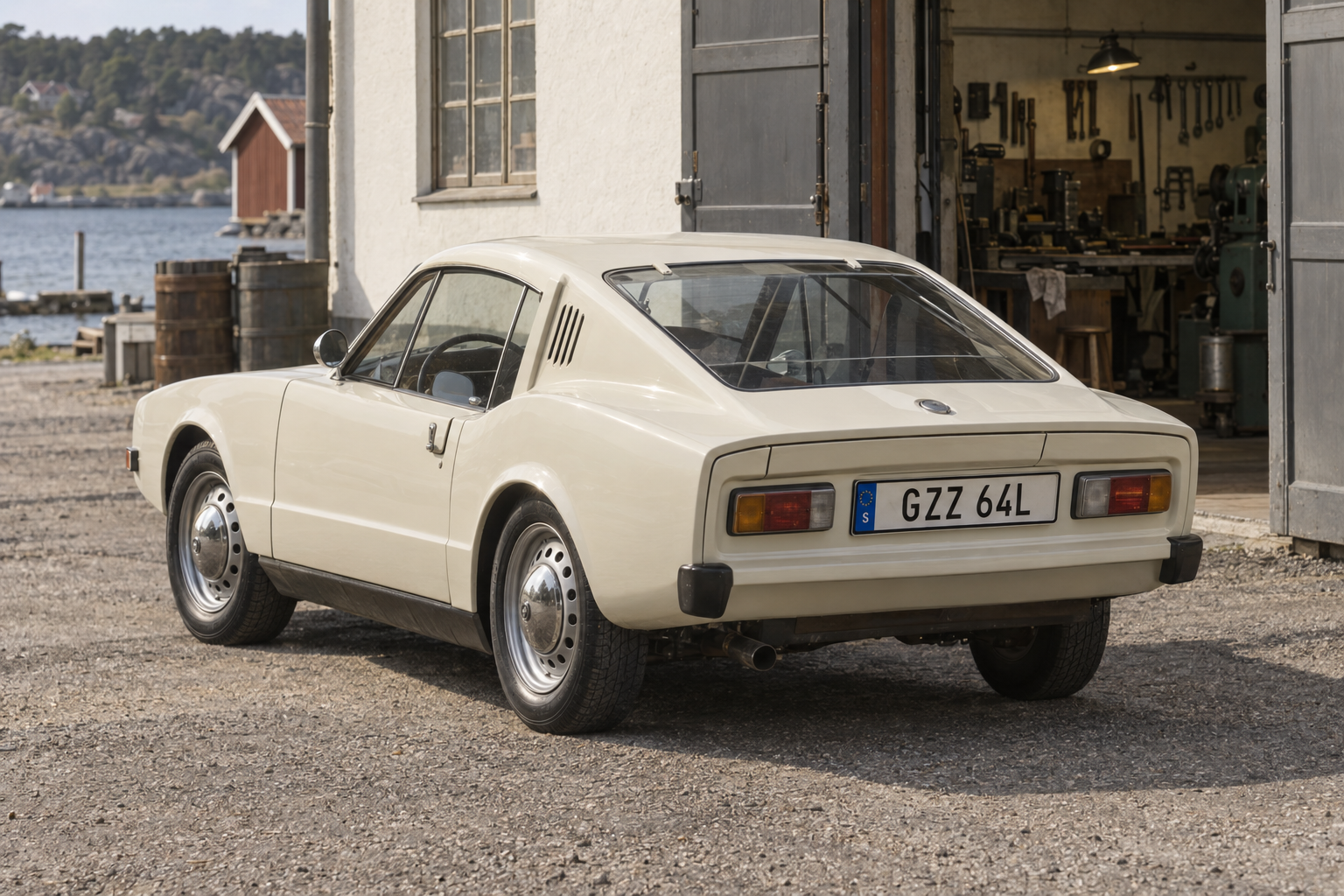
The shape was compact and rather distinctive. The round headlamps sat beneath transparent covers, the cabin was narrow and the rear end short. The entire front section could be tilted forwards to provide access to the engine and front suspension. It is a detail that both looks race-inspired and has a thoroughly everyday value when something needs unbolting.
Inside, there was room for two, with the seats close together and the instruments grouped in front of the driver. Gearchanges were made using a column-mounted lever, a clear sign of kinship with the more practical Saab models. Anyone expecting every detail to follow British or Italian sports car convention had to think again. The Sonett was built around Saab’s solutions, not around some universal rulebook for how a sports car should look.
When the two-stroke had to make way
The first version used a tuned variant of Saab’s two-stroke engine. With the car’s low weight and compact powertrain, it suited the basic concept well. But during the same period, Saab’s regular passenger cars were moving towards four-stroke power, and the Sonett followed suit.
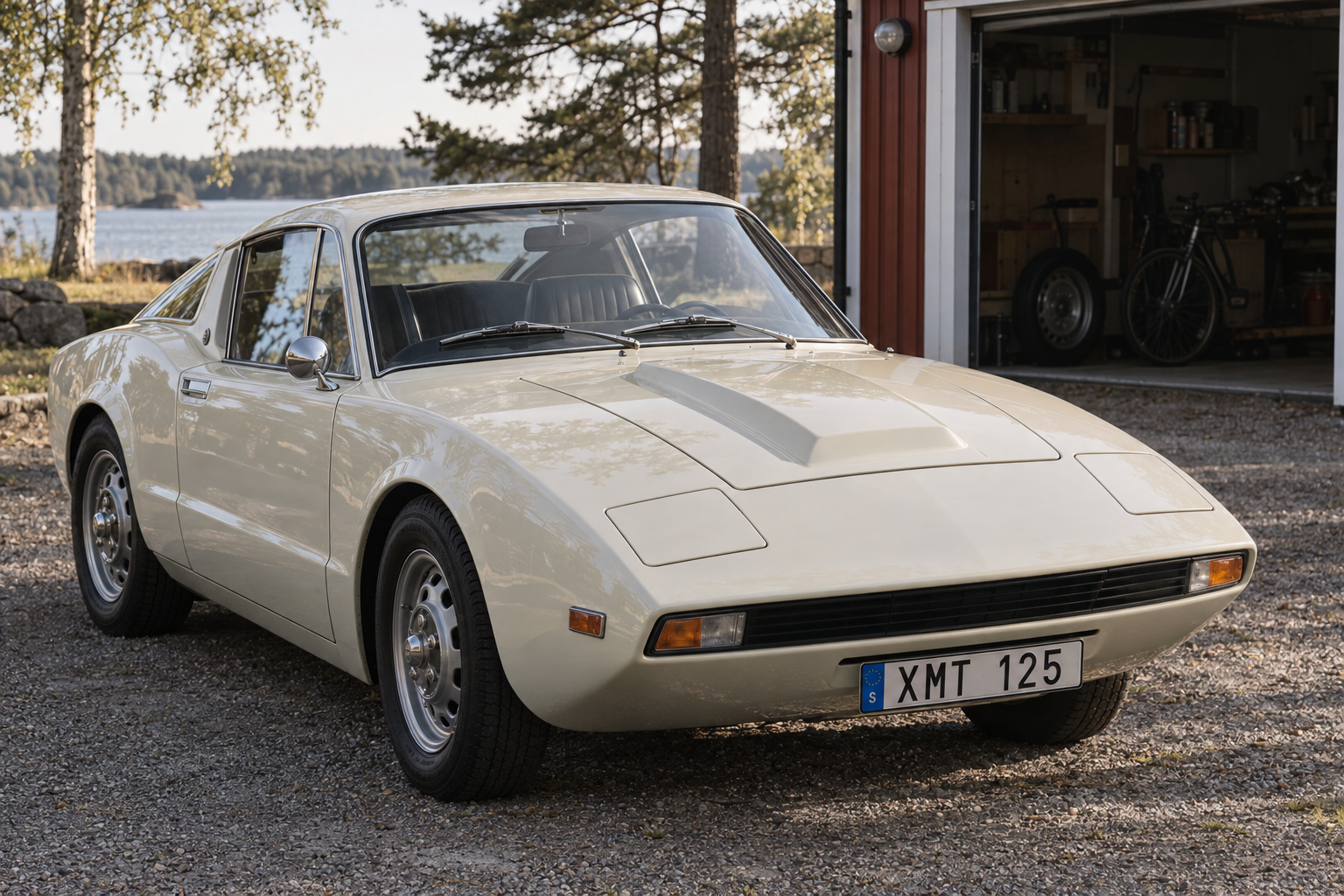
The Sonett V4 arrived during 1967, still within the Saab 97 model family. It received the Ford-built V4 engine also used in the Saab 95 and 96. This tied the sports car more closely to the engineering Saab was now investing in for its higher-volume models. The change was therefore about more than simply getting a different engine character.
The new engine needed more vertical space. The solution was the clearly visible bonnet bulge, the easiest way to distinguish the V4 version from the earlier two-stroke. The car literally had to tailor its suit to what lay inside. It was hardly a discreet alteration, but the detail makes it unusually clear what is under the bonnet.
The Sonett was intended as a small road-going sports car for two, not as a long-distance family car. Front-wheel drive set it apart from many contemporary rivals, while low weight was central to its performance. This description is based on its design and intended use; the editorial team has not test-driven the car.
Small production run, big questions when buying
A total of 258 examples of the two-stroke Sonett II and 1 610 Sonett V4s were built. Production of this body generation ended in 1969, before the Sonett III took over in 1970. That makes the two-stroke particularly unusual, but rarity does not guarantee a particular market value.
For the collector, identity and condition matter more than shiny paint. Check the chassis number, documentation and that the engine variant and body specification match the car’s history. Fibreglass does not rust, but the steel chassis beneath it can. Older body repairs, cracks and missing model-specific parts also deserve careful scrutiny.
A well-documented restoration can therefore carry considerable weight. Quoting a general price can easily be misleading with such small production runs: originality, completeness and the work carried out can vary greatly between examples. The Sonett’s charm lies precisely in its combination of familiar Saab mechanicals and an unusual low-volume body. The former makes ownership easier; the latter demands patience.
Sources
- Saab Car Museum, Saab Car Museum
- Björn-Eric Lindh, Saab: The First 40 Years (1987)
- Nick Georgano (red.), The Beaulieu Encyclopedia of the Automobile (2000)
Ask questions about “Saab Sonett II – the sports car that gained a bulge in the bargain”. Answers are based on the magazine's own articles.