Renault Sport Spider – aluminum, mid-engine, and almost no everyday practicality
The French roadster that put driving above everything else
No conventional windshield at first, no real roof, and the engine behind the seats. The Renault Sport Spider was France’s refusal to compromise in the 1990s: a lightweight two-seat sports car inspired by race cars and built from Renault parts.
 By Nora LindqvistReporter · Sports cars and motorsports
Translated from Swedish with the help of AI.
From auto show shock to limited production
The Renault Sport Spider debuted at the Geneva Motor Show in 1995 and entered production in 1996. It was a new, dedicated sports car, not an open-top version of an existing Renault. The focus here is on the street-legal model, built at the Alpine factory in Dieppe until 1999. Alongside it was a dedicated racing version for the Spider Trophy one-make series.
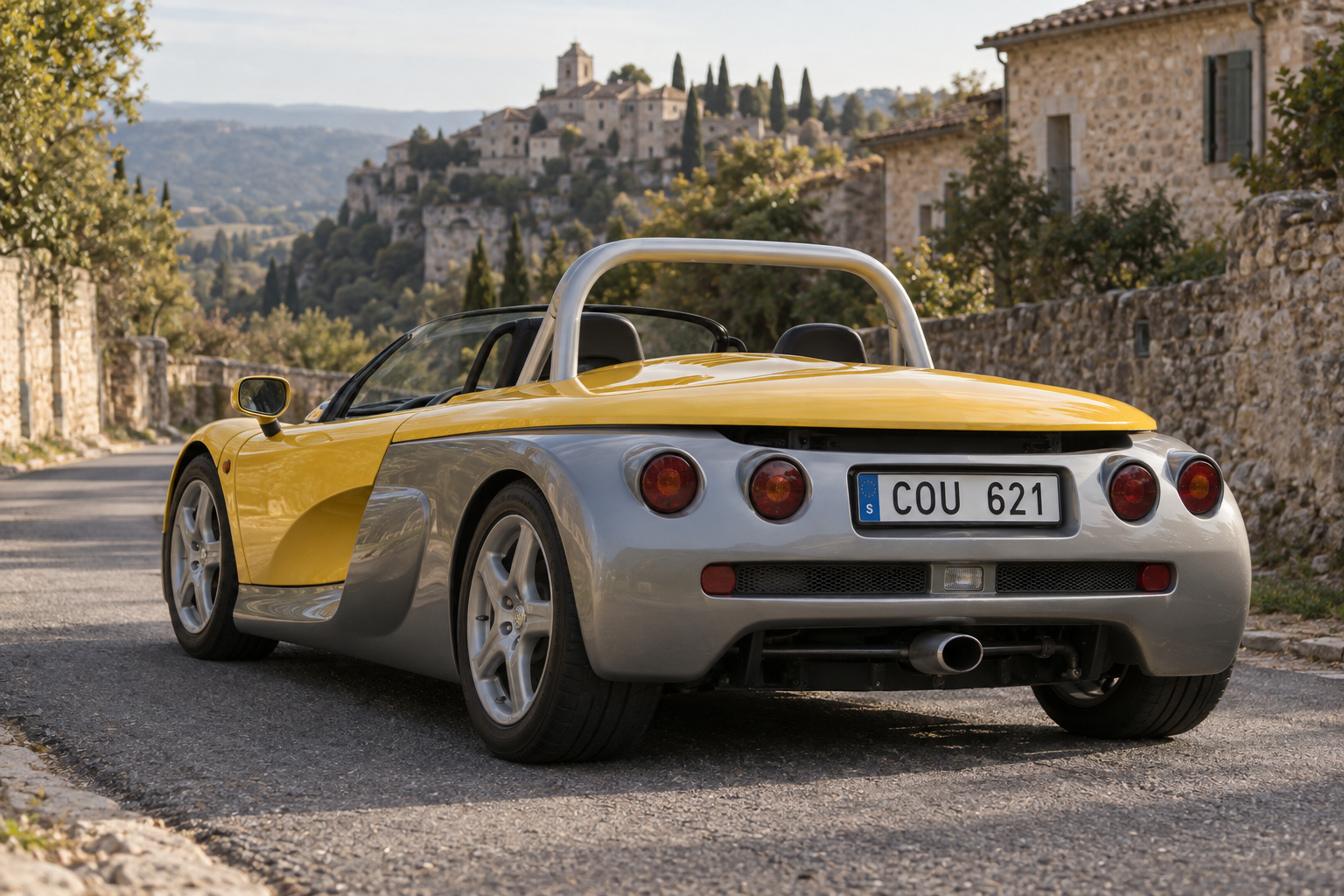
The timing was well chosen. Renault had a strong presence in Formula 1 as an engine supplier, but the brand’s regular showrooms were dominated by practical passenger cars. The Spider gave that motorsport connection a physical form: a low nose, two seats, and an engine positioned between the cockpit and the rear axle. It was not meant to replace the family car. It was meant to give Renault a sports car that did not need decals to explain itself.
The Lotus Elise launched at the same time, making the comparison inevitable. Both built their identities around low weight and an aluminum chassis. But the Spider chose its own look, broader across the shoulders and more conspicuously stripped down. It was also the first production road car to carry Renault Sport as a model brand in its own right.
The chassis took center stage
Beneath the composite body is a chassis made from aluminum sections welded together. That is an important distinction from the Elise, whose aluminum structure was bonded instead. Renault’s approach created a clear, almost industrial architecture in which structural components also became part of the car’s visual identity.
The suspension uses double wishbones front and rear. This design allows control over wheel angles as the suspension moves, something particularly relevant to a low-slung sports car with wide tires. The steering has no power assistance, and the brakes operate without power assistance or ABS. The driver therefore supplies both the steering effort and the pedal pressure, without the aids that had already become common even in much more basic cars.
The engine is less exotic than the chassis. The two-liter, sixteen-valve four-cylinder comes from the same engine family used in the Clio Williams and is mounted transversely behind the cockpit. A five-speed manual transmission sends power to the rear wheels. No turbo, no selectable drive modes: the recipe is immediate throttle response, modest mass, and a powertrain you can understand without an instructional video.
The relatively low power output should therefore be considered alongside the weight, not in isolation. The Spider was built for acceleration, changes of direction, and mechanical involvement rather than winning a contest for the highest top speed. The mid-engine layout also concentrates much of the powertrain’s mass near the center of the car.
A windshield was not a given
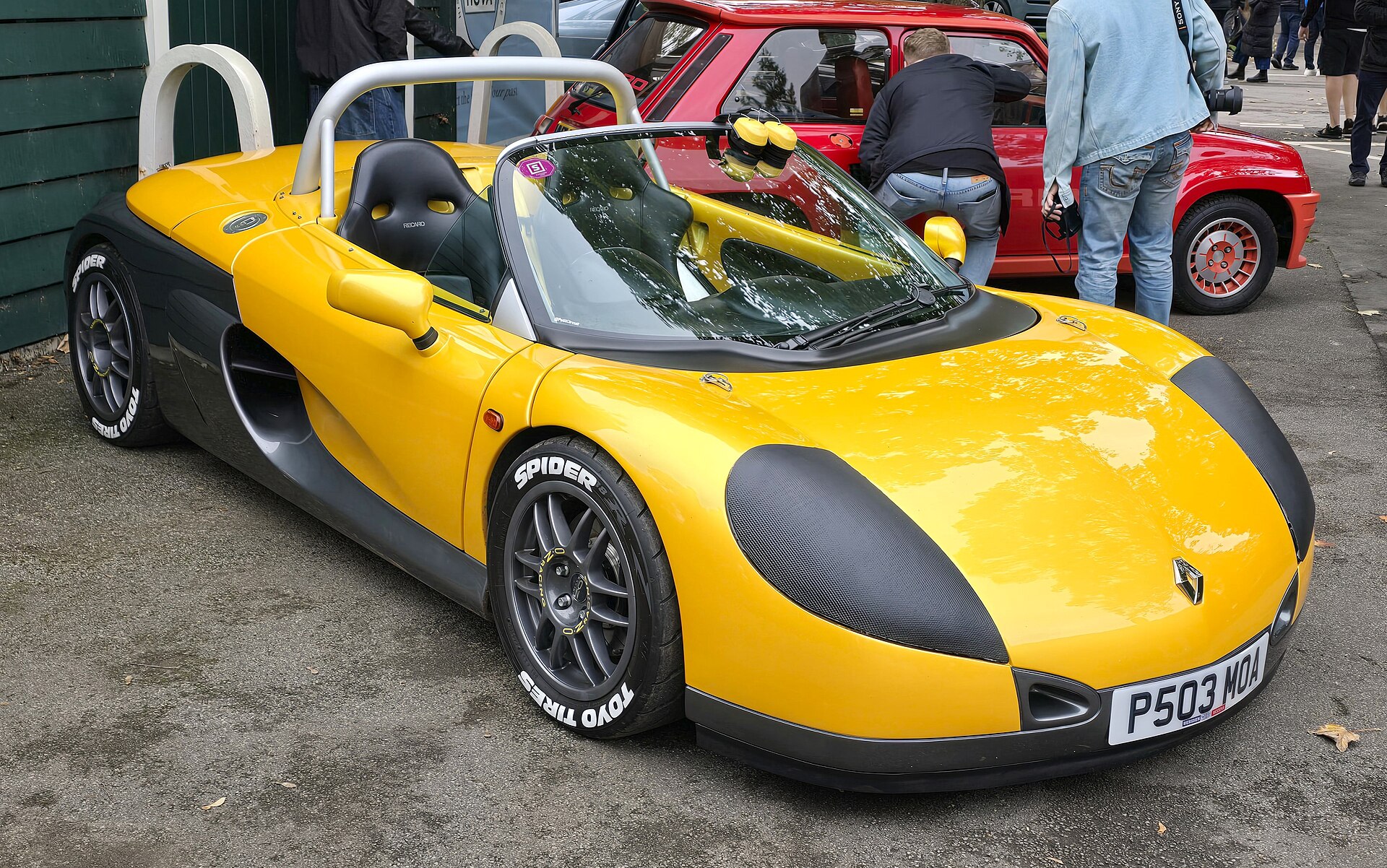
The original version’s most striking detail was the absence of a conventional windshield. Instead, it used a low wind deflector intended to direct the oncoming air over the cockpit. It was an aerodynamic solution for managing airflow, not comprehensive protection against weather, road grime, or insects. A helmet was therefore a natural part of using the car.
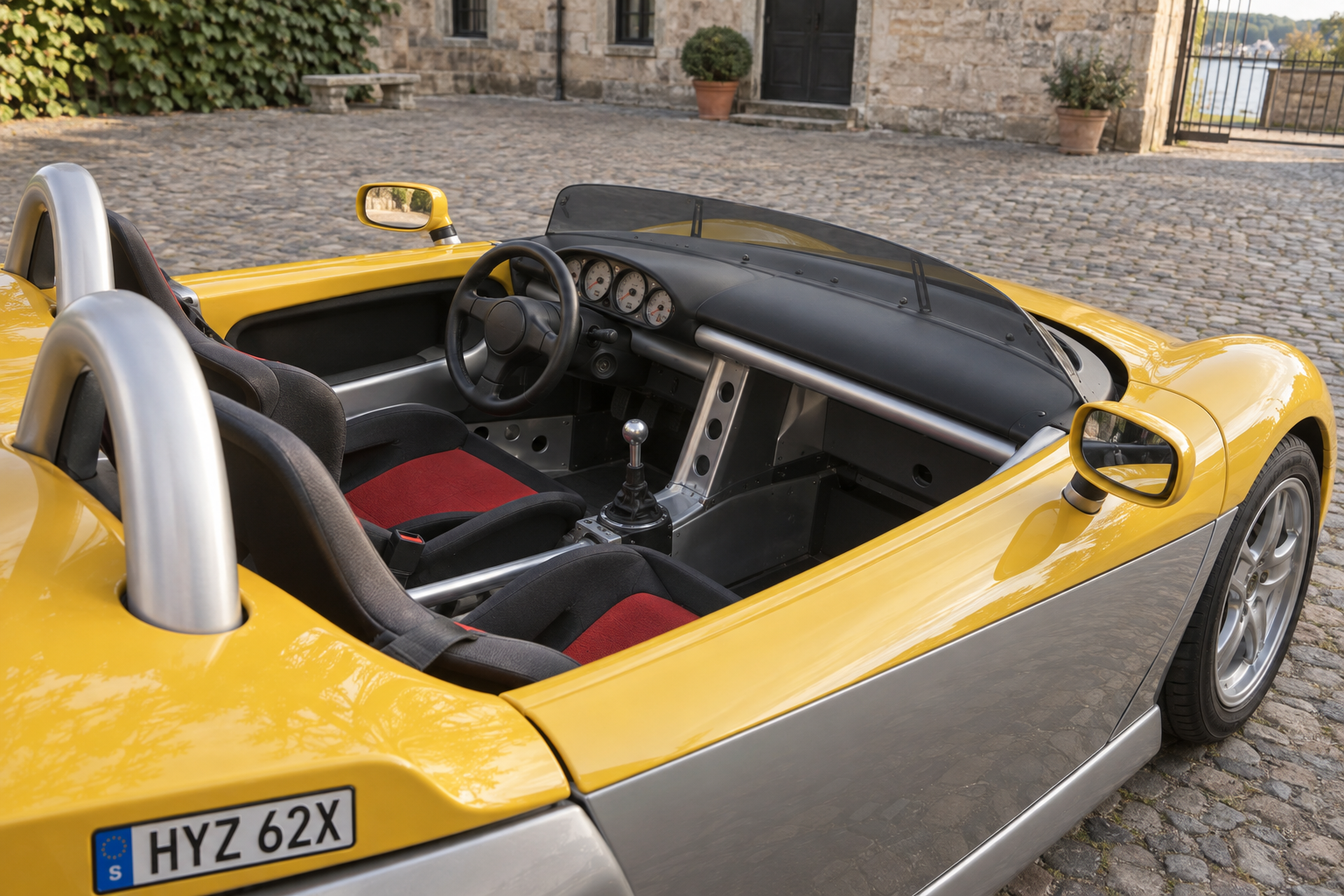
A version with a proper windshield was added during the production run. It made the car more usable on the road, but did not turn it into a comfortable long-distance convertible. The cockpit remained open and simple, with bucket seats, exposed structural components, and very little to distract from the driving itself.
The doors open upward, adding to the spectacle. But there is a consistent idea behind the shape: the body wraps around the wheels, engine, and driver without pretending to offer the comforts of an everyday car. The low front end, distinct headlight shapes, and substantial rollover protection make the Spider instantly recognizable even without Renault badges.
A sports car to buy with your eyes open
The Spider Trophy gave the model a concrete role in racing. The cup cars should not be confused with the road versions, however; specifications, equipment, and usage history can differ substantially. Our editorial team has not test-driven the Spider. Even so, its intended use is clear from its design: short, engaging road drives and track sessions rather than commuting with luggage.
Today, the Spider trades as a collector car. A general price can easily be misleading without a date, market, and documented condition, especially when windshield configuration, originality, and any racing history vary. For a buyer, a well-documented example tells you more than a tempting ad headline.
Above all, inspect the aluminum structure for damage or repairs, the body mounting points, and the availability of model-specific parts. Also check the service history and documentation of timing belt replacement. The engine’s relationship to other Renault models does not automatically make every repair easier. The Spider is special precisely because so much around the engine was built for a single, uncompromising purpose.
Sources
- Renault – The Originals, Spider
- Nick Georgano (red.), The Beaulieu Encyclopedia of the Automobile (2000)
- Wikipedia, Renault Spider
Ask questions about “Renault Sport Spider – aluminum, mid-engine, and almost no everyday practicality”. Answers are based on the magazine's own articles.